Walmart_Sales_Exploratory_Data_Analysis_Project
🛒 Walmart Sales EDA(Exploratory Data Analysis) Project
General Topics:
-
Import the libraries
-
Load the Dataset
-
Drop Duplicate Rows
-
Change column format(if need)
import numpy as np
import pandas as pd
import matplotlib.pyplot as plt
import seaborn as sns
df = pd.read_csv(r"D:\B_Data_Anlysist_Project\Python_Projects\02_Walmart_EDA\eda_walmart_sales_dataset.csv")
df.head()
df.info()
<class 'pandas.core.frame.DataFrame'>
RangeIndex: 1000 entries, 0 to 999
Data columns (total 10 columns):
 #   Column         Non-Null Count  Dtype
---  ------         --------------  -----
 0   Order ID       1000 non-null   object
 1   Order Date     1000 non-null   object
 2   Customer ID    1000 non-null   object
 3   Customer Name  1000 non-null   object
 4   City           1000 non-null   object
 5   Region         1000 non-null   object
 6   Category       1000 non-null   object
 7   Quantity       1000 non-null   int64
 8   Sales          1000 non-null   float64
 9   Profit         1000 non-null   float64
dtypes: float64(2), int64(1), object(7)
memory usage: 78.3+ KB
df.drop_duplicates(inplace= True)
df["Order Date"] = pd.to_datetime(df["Order Date"])
df.info()
<class 'pandas.core.frame.DataFrame'>
RangeIndex: 1000 entries, 0 to 999
Data columns (total 10 columns):
 #   Column         Non-Null Count  Dtype
---  ------         --------------  -----
 0   Order ID       1000 non-null   object
 1   Order Date     1000 non-null   datetime64[ns]
 2   Customer ID    1000 non-null   object
 3   Customer Name  1000 non-null   object
 4   City           1000 non-null   object
 5   Region         1000 non-null   object
 6   Category       1000 non-null   object
 7   Quantity       1000 non-null   int64
 8   Sales          1000 non-null   float64
 9   Profit         1000 non-null   float64
dtypes: datetime64[ns](1), float64(2), int64(1), object(6)
memory usage: 78.3+ KB
Q1. Customer Segmentation Challenge:
Identify the top 10% of customers who contributed the most to the total profit. What common characteristics (region, category, city) do they share?
customer_profit = df.groupby("Customer ID")["Profit"].sum().reset_index()
customer_profit
customer_profit = customer_profit.sort_values(by= "Profit", ascending= False)
customer_profit
top_10_percent_num = int(0.10 * customer_profit.shape[0])
top_10_percent_num
top_10_percent_df = customer_profit.head(top_10_percent_num)
top_10_percent_df
top_df = df[df["Customer ID"].isin(top_10_percent_df["Customer ID"])]
top_df
Region column:
region = top_df["Region"].value_counts()
region_index = region.index
region_values = region.values
region = top_df["Region"].value_counts()
region
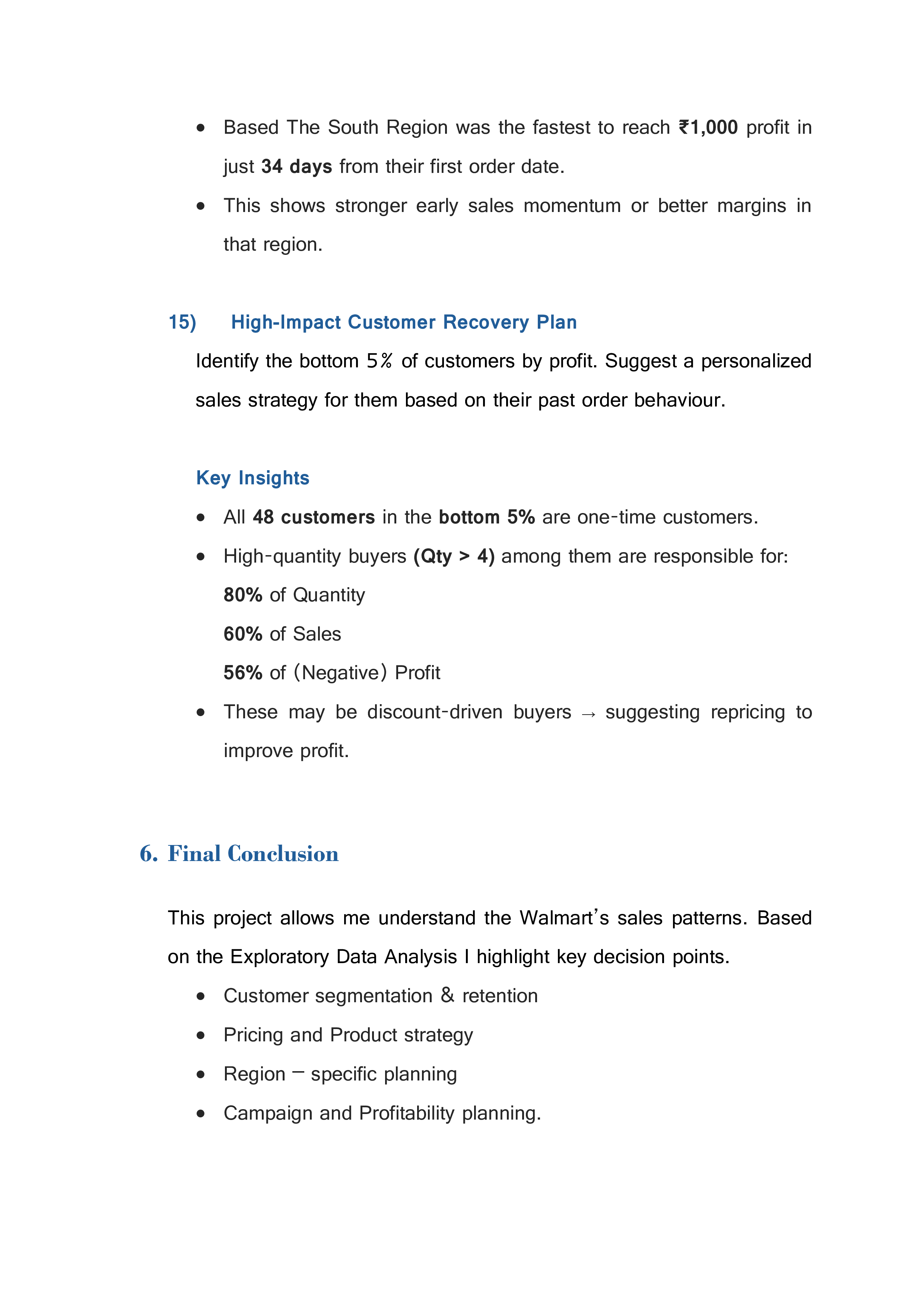
Region
West     30
East     26
North    25
South    25
Name: count, dtype: int64
sns.barplot(x= region_index, y= region_values)
plt.show
Category column:
category = top_df["Category"].value_counts()
category_index = category.index
category_value = category.values
print(top_df["Category"].value_counts())
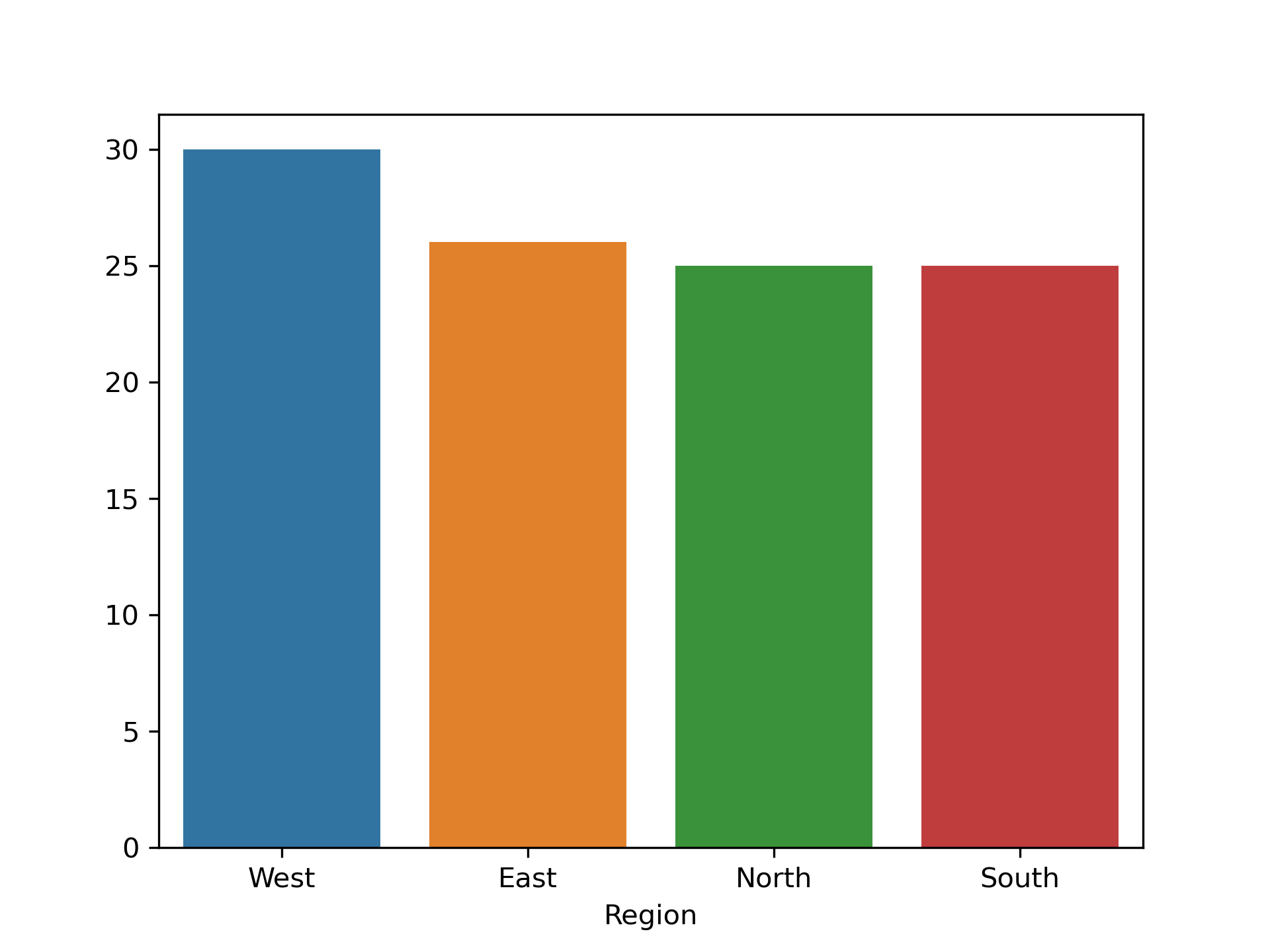
Category
Furniture          39
Office Supplies    37
Technology         30
Name: count, dtype: int64
sns.barplot(x= category_index,y= category_value)
plt.show()
print(top_df["City"].value_counts().head(10))
City
South Megan          2
South Alyssamouth    1
Reyesmouth           1
North Sandyfurt      1
South Ashleyhaven    1
Craigport            1
New Stephanie        1
Ricefurt             1
Melissatown          1
New Rachaelhaven     1
Name: count, dtype: int64
Conclusion:
-
Region: Distribution is fairly even, but [East] has a slight edge. -
Category: [Furniture] appears more frequently. -
City: One or two cities like [South Megan] show up more than once, but no strong city dominance.
Q2. Monthly Sales Recovery Strategy:
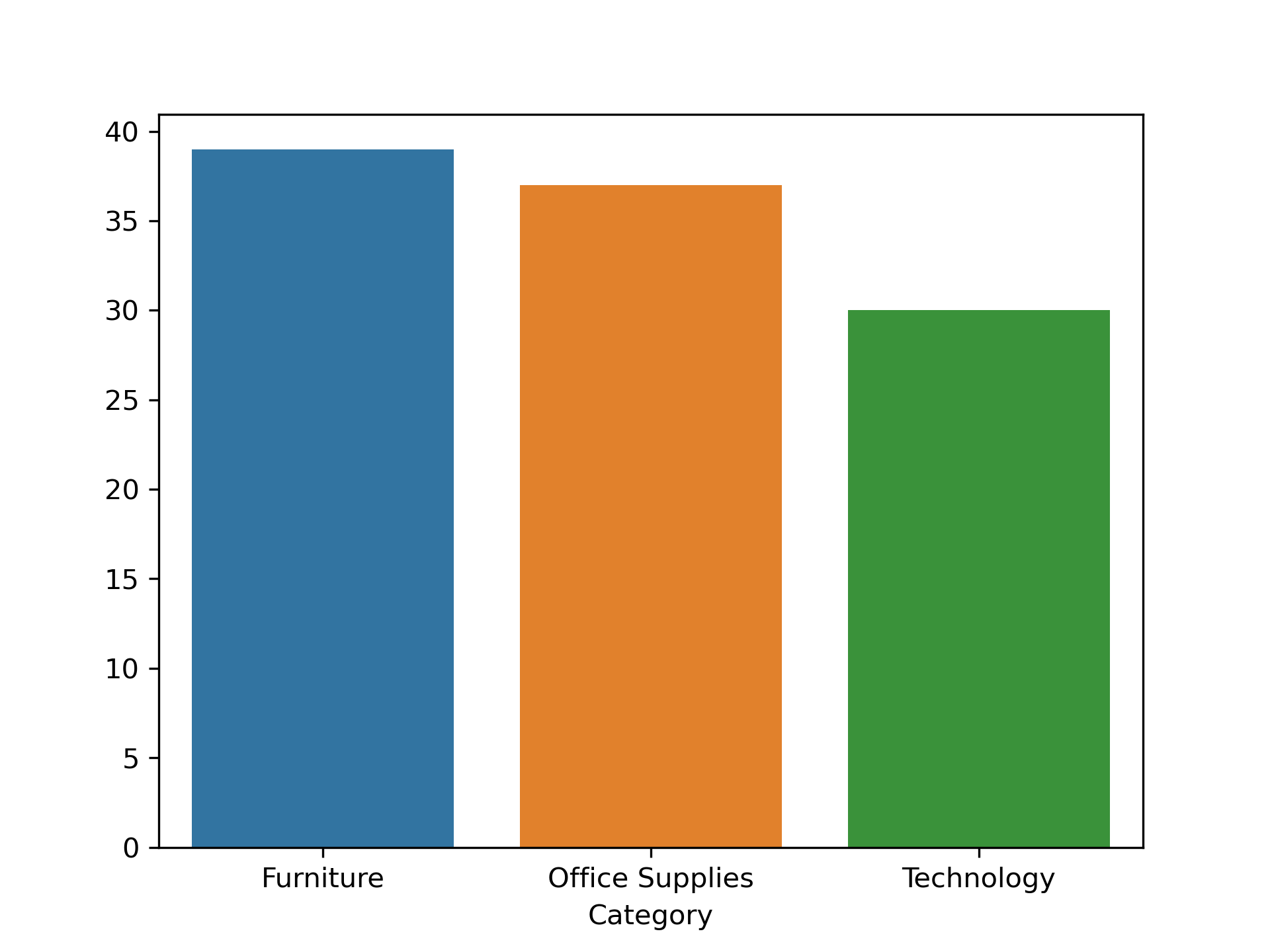
Determine which month in the past year had the lowest overall profit. What specific product category and region contributed most to this loss?
df_loss = pd.DataFrame(df)
df_loss.head()
df_loss["Order Date"].nunique()
df_loss["Year"] = df_loss["Order Date"].dt.year
df_loss["Month"] = df_loss["Order Date"].dt.month
df_loss["Year"].unique()
array([2024, 2023, 2025])
df_loss["Year"].value_counts()
Year
2024    492
2025    275
2023    233
Name: count, dtype: int64
df_2024 = df_loss[df_loss["Year"] == 2024]
df_2024
Monthly profit:
df_2024_months = df_2024.groupby("Month")["Profit"].sum().reset_index()
df_2024_months
df_2024_months = df_2024_months.sort_values(by= "Profit", ascending= False)
df_2024_months
sns.barplot(x= df_2024_months["Month"], y= df_2024_months["Profit"])
plt.show()
df_march = df_2024[df_2024["Month"] == 3]
df_march.head()
df_march["Profit"].info()
<class 'pandas.core.series.Series'>
Index: 41 entries, 8 to 993
Series name: Profit
Non-Null Count  Dtype
--------------  -----
41 non-null     float64
dtypes: float64(1)
memory usage: 656.0 bytes
df_march["Profit"].sum()
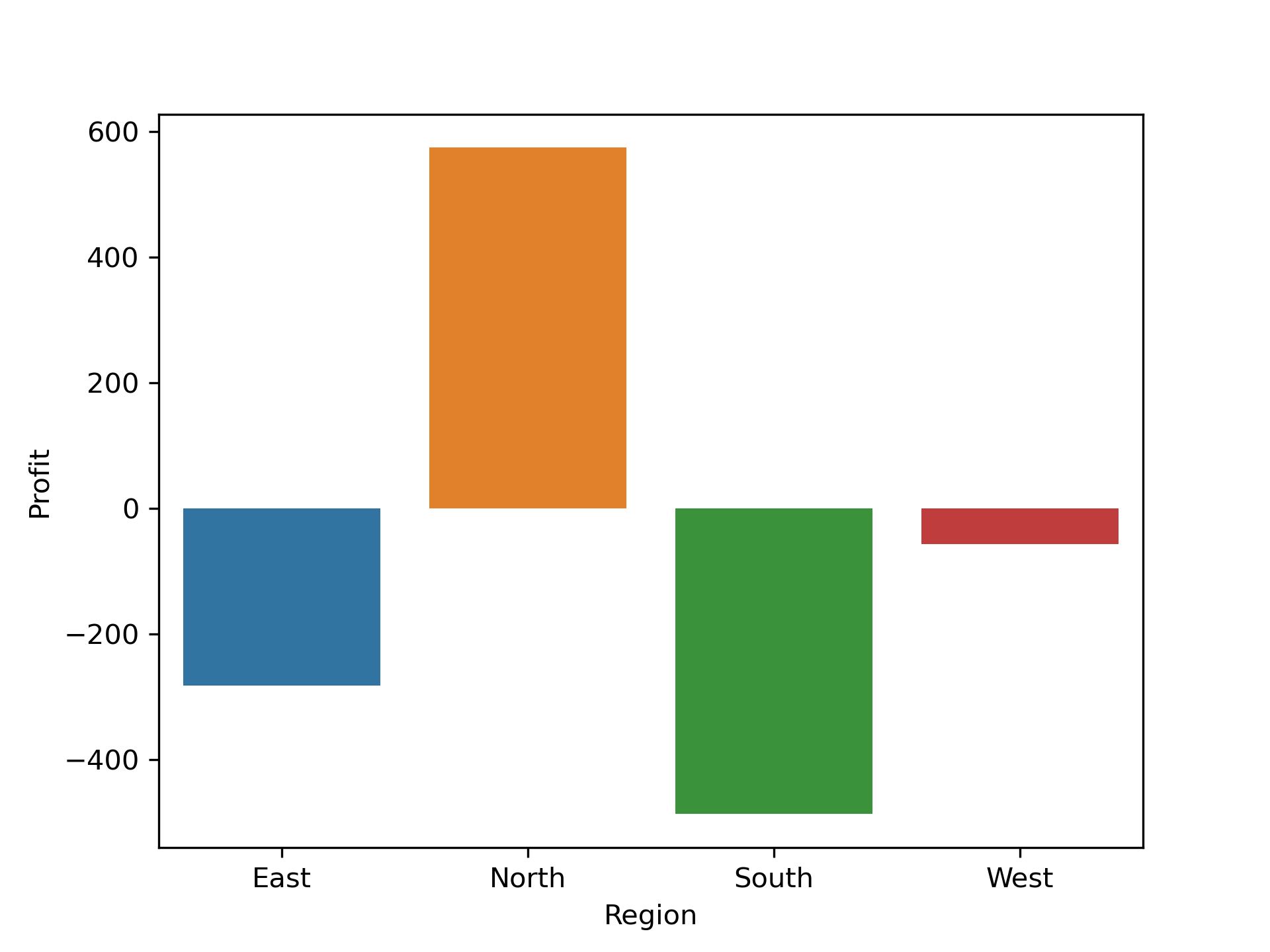
Region wise Distribution:
df_march["Region"].value_counts()
Region
North    13
South    11
West     10
East      7
Name: count, dtype: int64
region = df_march.groupby("Region")["Profit"].sum()
region
Region
East    -282.76
North    574.55
South   -486.86
West     -57.15
Name: Profit, dtype: float64
region.index
region.values
sns.barplot(x= region.index, y= region.values)
plt.ylabel("Profit")
plt.show()
Category wise Distribution:
df_march["Category"].value_counts()
Category
Office Supplies    18
Furniture          12
Technology         11
Name: count, dtype: int64
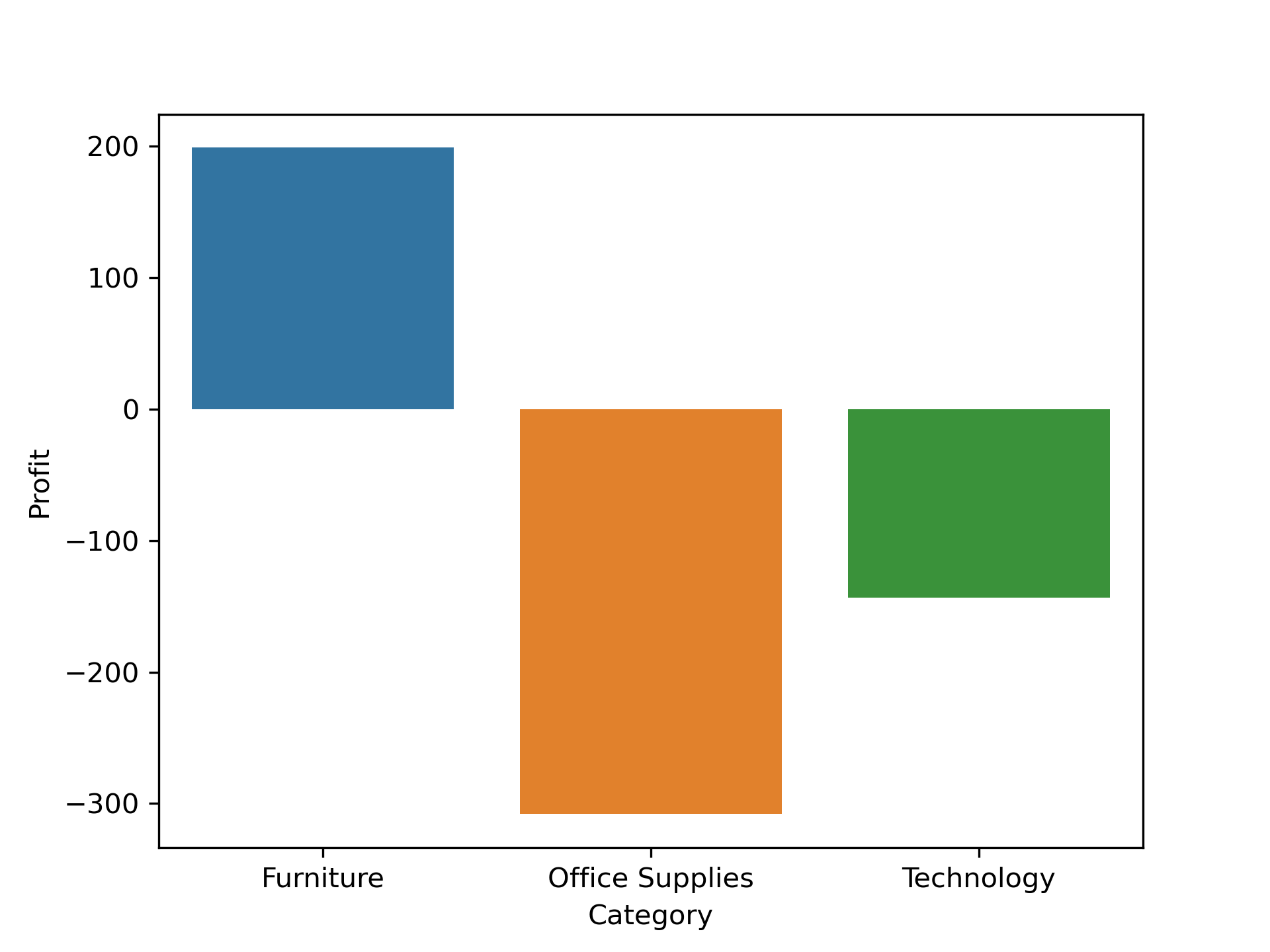
Category = df_march.groupby("Category")["Profit"].sum()
Category
Category
Furniture          199.04
Office Supplies   -307.96
Technology        -143.30
Name: Profit, dtype: float64
Category.index
Category.values
sns.barplot(x= Category.index, y= Category.values)
plt.ylabel("Profit")
plt.show()
Both wise Distribution:
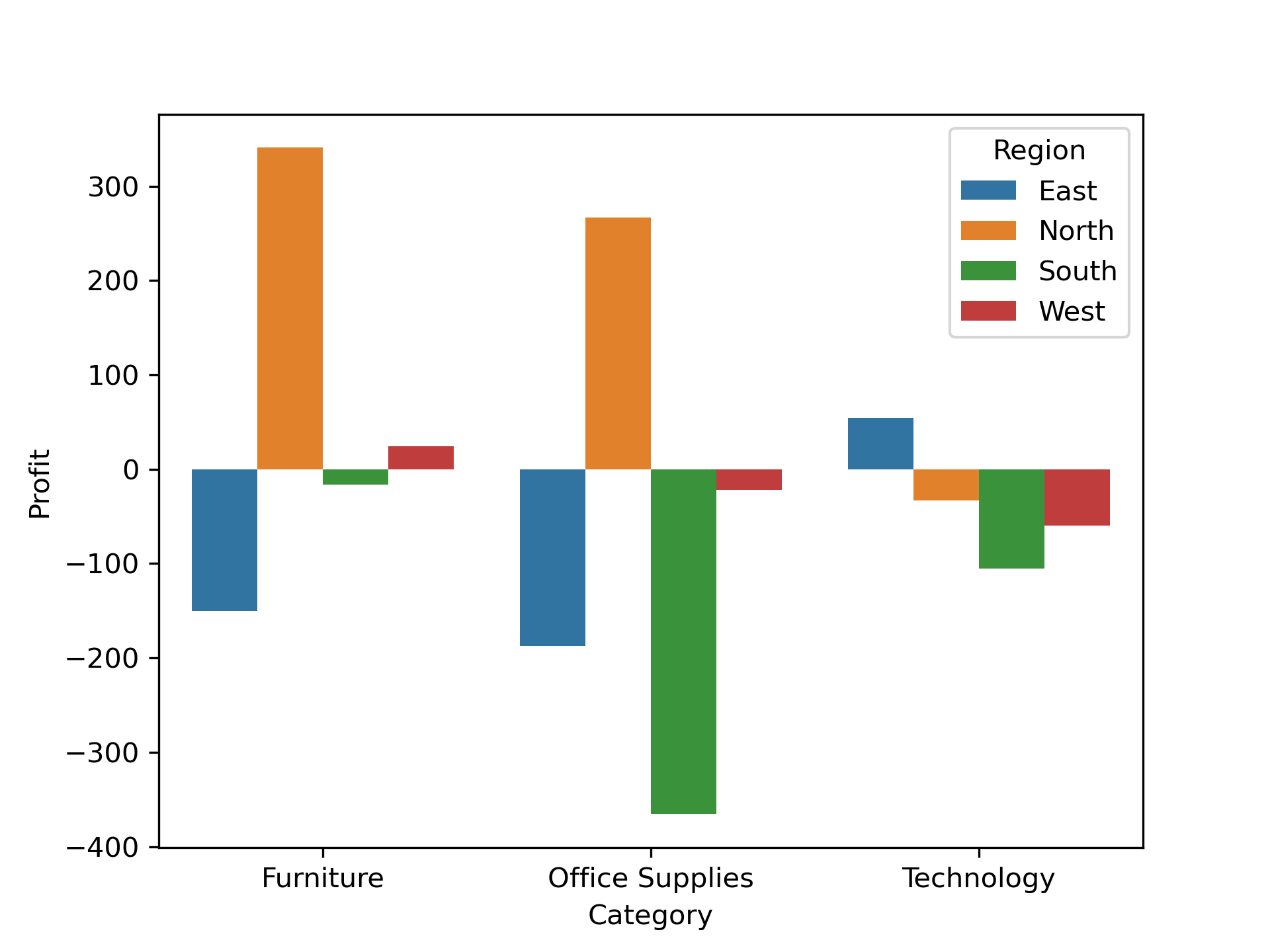
df_march.groupby(["Category","Region"])["Profit"].sum()
Category         Region
Furniture        East     -150.12
                 North     340.85
                 South     -16.23
                 West       24.54
Office Supplies  East     -187.05
                 North     266.55
                 South    -365.34
                 West      -22.12
Technology       East       54.41
                 North     -32.85
                 South    -105.29
                 West      -59.57
Name: Profit, dtype: float64
grouped = df_march.groupby(["Category", "Region"])["Profit"].sum().reset_index()
sns.barplot(x="Category", y="Profit", hue="Region", data=grouped)
plt.show()
Conclusion:
-
Past year is
2024– 492 records. -
MarchMonth make the least amount of loss profit. Loss is-252.22. -
March month dissection Region wise
Southmade a more amount of lose. Loss is-486.86. -
Category wise
Office Suppliesmade a more amount of lose. Loss is-307.96. -
Both
RegionandCategorywisesouth&Office Suppliesmade a more amount of lose. Loss is-365.34.
Q3. Profitability Anomaly Detection:
Identify any orders with high sales but negative profit. What patterns do you notice in terms of region, category, or quantity?
df_anomaly = pd.DataFrame(df)
df_anomaly
df_neg_profit = df_anomaly[df_anomaly["Profit"] < 0]
df_neg_profit
df_neg_profit.groupby("Category").agg({"Category" : "count"})
df_neg_profit["Quantity"].unique()
array([7, 8, 6, 2, 1, 9, 3, 5, 4], dtype=int64)
Furniture Distribution:
df_count_furniture = df_neg_profit[df_neg_profit["Category"] == "Furniture"].groupby("Quantity")["Profit"].count()
df_count_furniture
Quantity
1    16
2    10
3    14
4     7
5     9
6    19
7    14
8    15
9    11
Name: Profit, dtype: int64
df_neg_profit_furniture = df_neg_profit[df_neg_profit["Category"] == "Furniture"].groupby("Quantity")["Profit"].sum()
df_neg_profit_furniture
Quantity
1    -802.44
2    -577.02
3    -805.80
4    -389.89
5    -630.29
6   -1181.15
7    -607.38
8    -688.04
9    -532.80
Name: Profit, dtype: float64
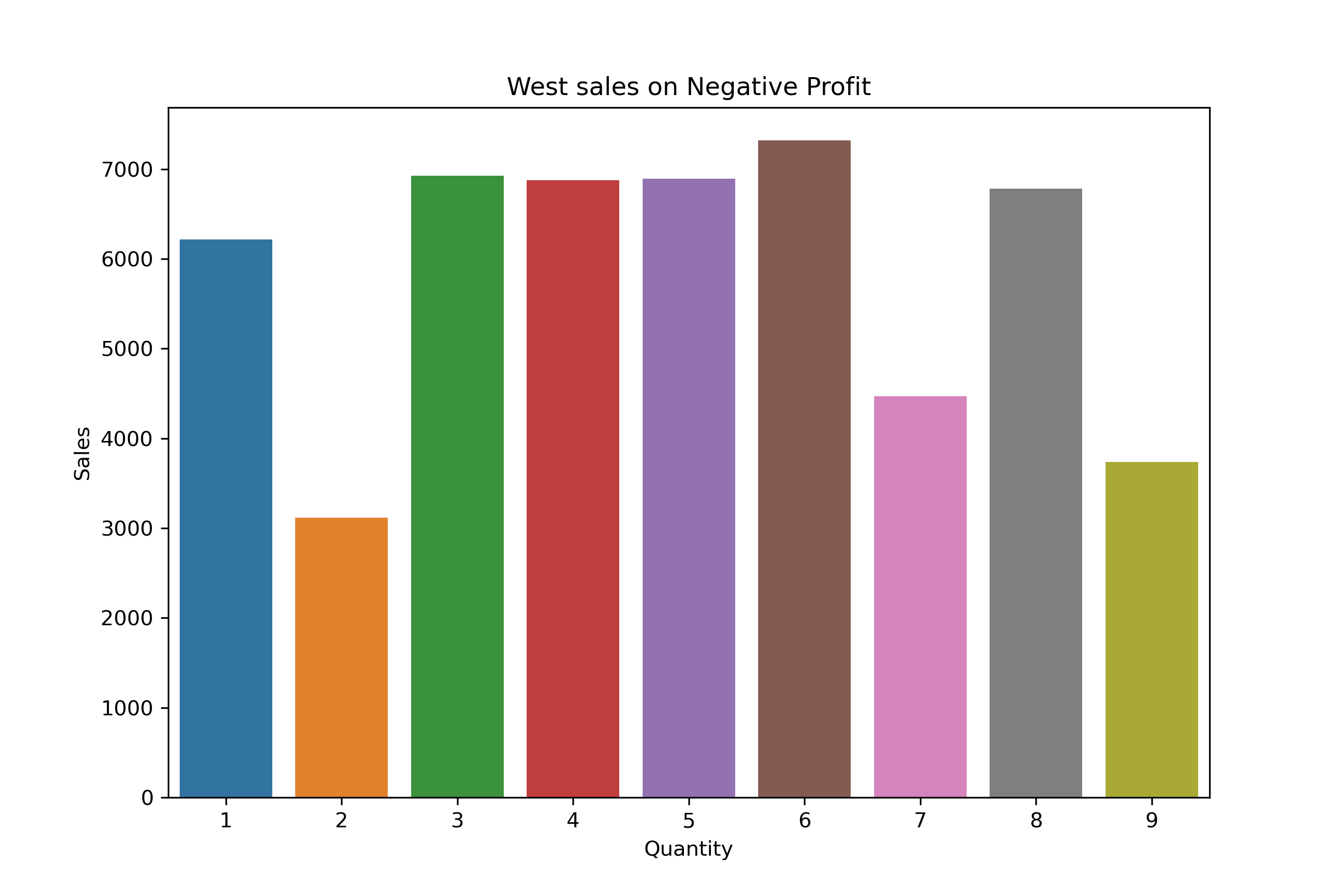
df_furniture = df_neg_profit[df_neg_profit["Category"] == "Furniture"].groupby("Quantity")["Sales"].sum()
df_furniture
Quantity
1    9013.62
2    5562.43
3    7801.78
4    3806.66
5    4987.83
6    9700.03
7    5712.62
8    5971.68
9    5570.56
Name: Sales, dtype: float64
plt.figure(figsize = (9,6))
sns.barplot(x= df_furniture.index, y= df_furniture.values)
plt.title("Furniture sales on Negative Profit")
plt.ylabel("Sales")
plt.show()
Office_Suppliers Distribution:
df_count_Office_Supplies = df_neg_profit[df_neg_profit["Category"] == "Office Supplies"].groupby("Quantity")["Profit"].count()
df_count_Office_Supplies
Quantity
1    16
2    13
3    21
4    12
5    17
6    18
7    14
8    15
9    16
Name: Profit, dtype: int64
df_neg_Office_Supplies = df_neg_profit[df_neg_profit["Category"] == "Office Supplies"].groupby("Quantity")["Profit"].sum()
df_neg_Office_Supplies
Quantity
1    -876.00
2    -661.01
3    -924.51
4    -628.67
5    -691.39
6   -1191.58
7    -562.95
8    -725.70
9    -582.02
Name: Profit, dtype: float64
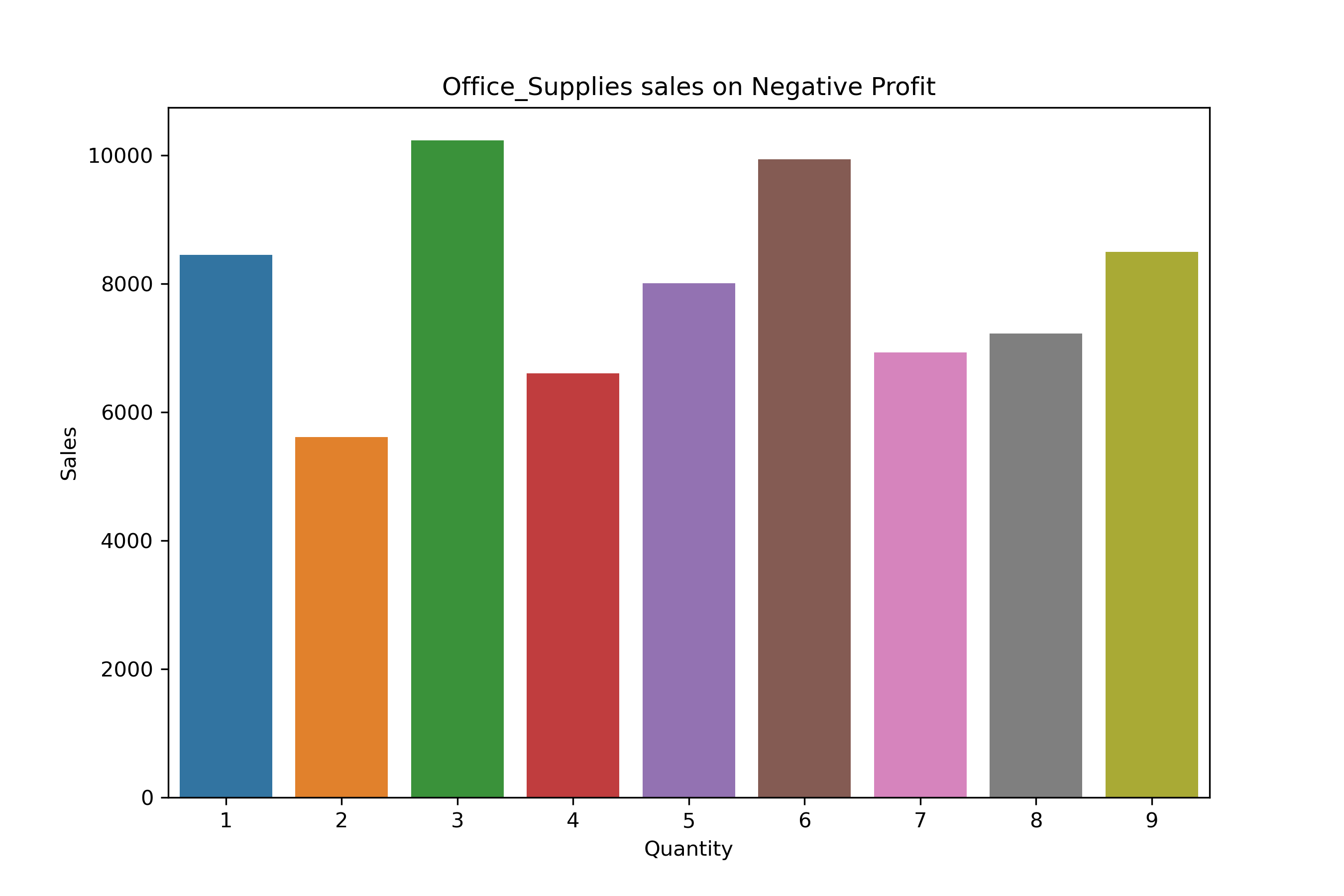
df_Office_Supplies = df_neg_profit[df_neg_profit["Category"] == "Office Supplies"].groupby("Quantity")["Sales"].sum()
df_Office_Supplies
Quantity
1     8454.98
2     5615.46
3    10234.87
4     6603.31
5     8006.98
6     9938.60
7     6935.57
8     7224.52
9     8494.63
Name: Sales, dtype: float64
plt.figure(figsize = (9,6))
sns.barplot(x= df_Office_Supplies.index, y= df_Office_Supplies.values)
plt.title("Office_Supplies sales on Negative Profit")
plt.ylabel("Sales")
plt.show()
Technology Distribution:
df_count_Technology = df_neg_profit[df_neg_profit["Category"] == "Technology"].groupby("Quantity")["Profit"].count()
df_count_Technology
Quantity
1    19
2    14
3    14
4    16
5    19
6    20
7    14
8    11
9    14
Name: Profit, dtype: int64
df_neg_Technology = df_neg_profit[df_neg_profit["Category"] == "Technology"].groupby("Quantity")["Profit"].sum()
df_neg_Technology
Quantity
1    -965.17
2    -710.43
3    -812.00
4    -604.46
5   -1283.44
6    -960.39
7    -625.54
8    -518.92
9    -884.20
Name: Profit, dtype: float64
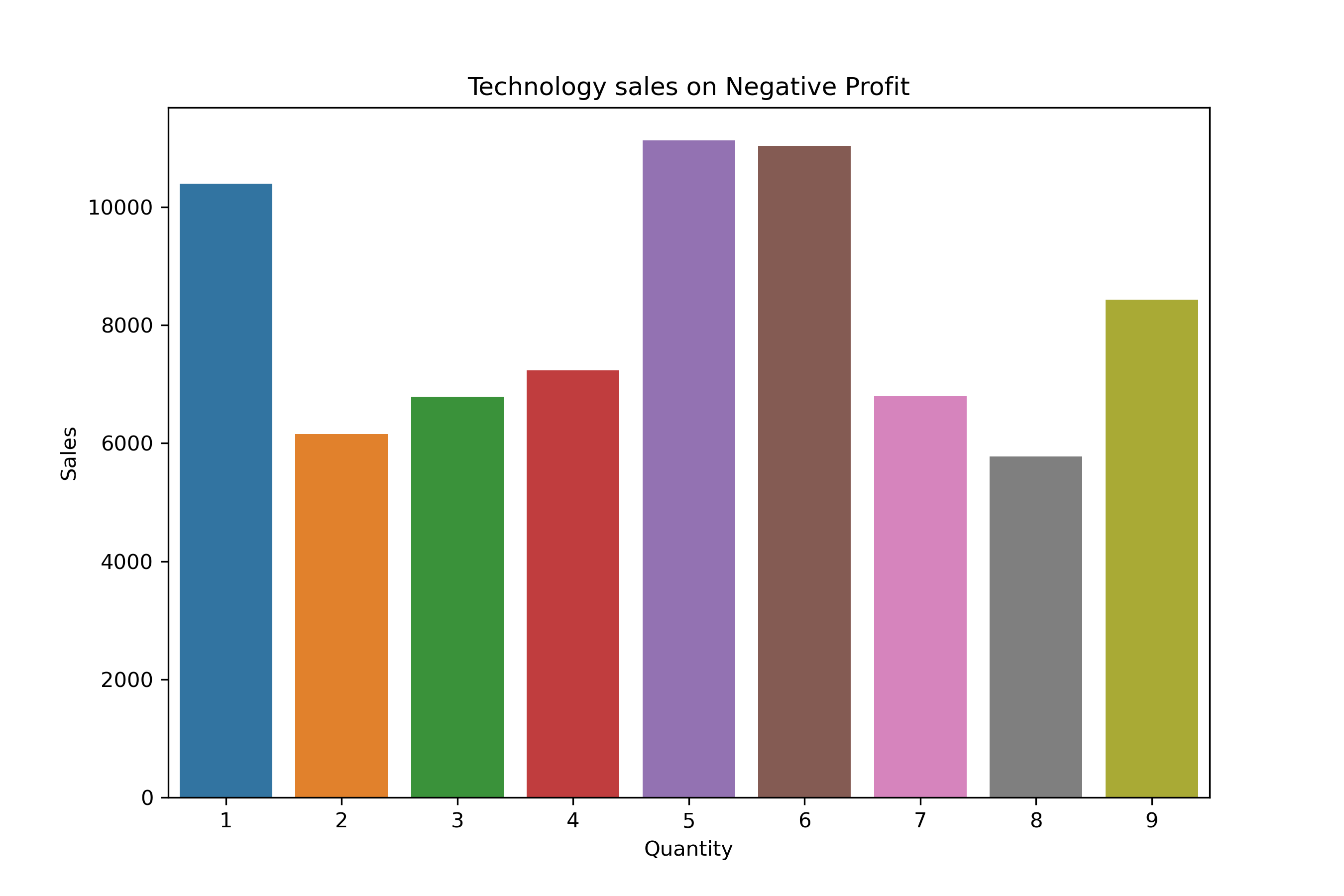
df_Technology = df_neg_profit[df_neg_profit["Category"] == "Technology"].groupby("Quantity")["Sales"].sum()
df_Technology
Quantity
1    10400.94
2     6155.91
3     6783.78
4     7235.92
5    11130.52
6    11033.73
7     6800.03
8     5772.87
9     8434.57
Name: Sales, dtype: float64
plt.figure(figsize = (9,6))
sns.barplot(x= df_Technology.index, y= df_Technology.values)
plt.title("Technology sales on Negative Profit")
plt.ylabel("Sales")
plt.show()
East Region Distribution:
df_neg_profit["Region"].unique()
array(['South', 'East', 'North', 'West'], dtype=object)
df_count_East = df_neg_profit[df_neg_profit["Region"] == "East"].groupby("Quantity")["Profit"].count()
df_count_East
Quantity
1    14
2    10
3    10
4     7
5    11
6    19
7    14
8    13
9    14
Name: Profit, dtype: int64
df_profit_East = df_neg_profit[df_neg_profit["Region"] == "East"].groupby("Quantity")["Profit"].sum()
df_profit_East
Quantity
1    -929.15
2    -454.48
3    -545.82
4    -517.64
5    -451.72
6   -1240.21
7    -704.56
8    -669.10
9    -681.08
Name: Profit, dtype: float64
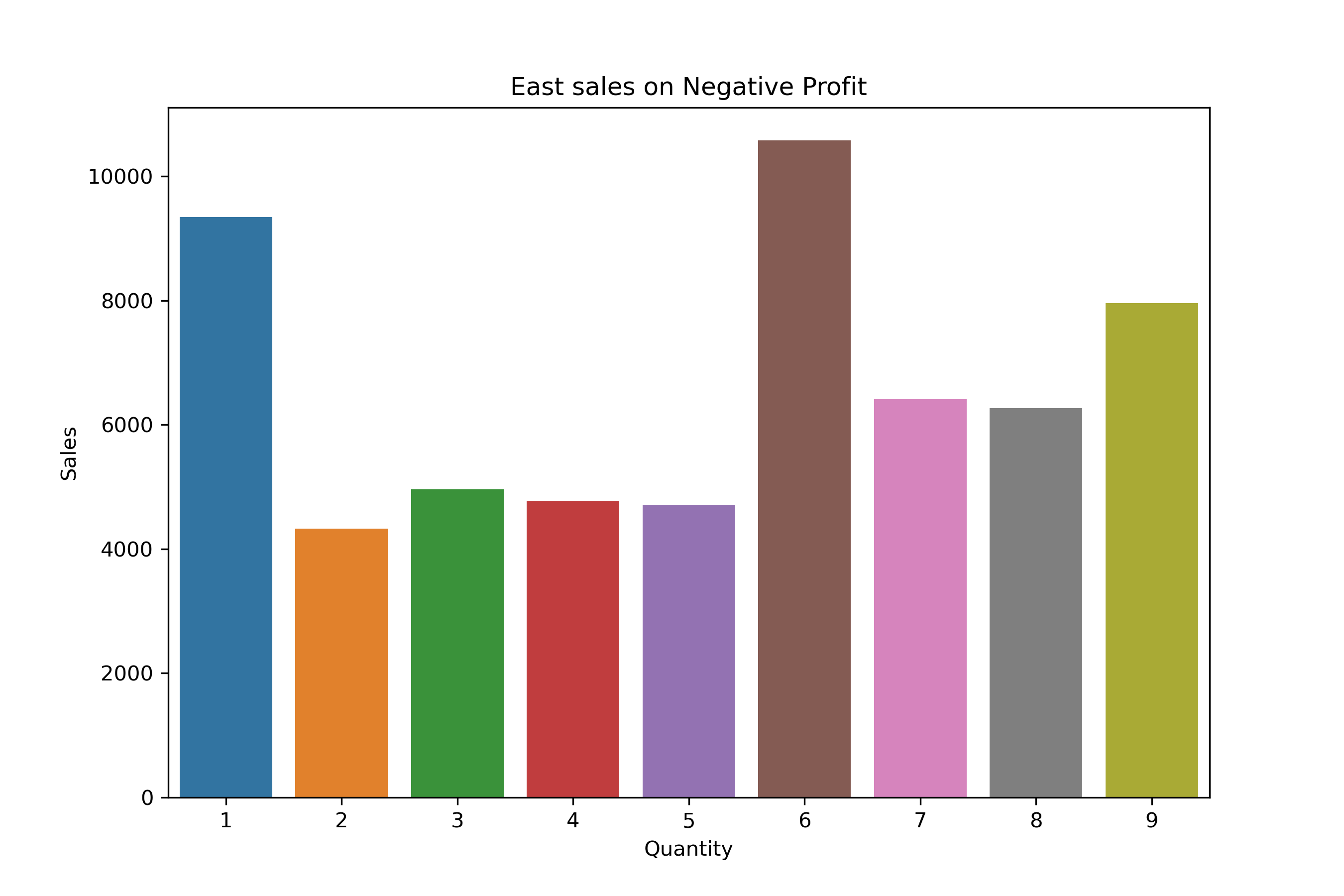
df_sales_East = df_neg_profit[df_neg_profit["Region"] == "East"].groupby("Quantity")["Sales"].sum()
df_sales_East
Quantity
1     9344.71
2     4328.10
3     4958.74
4     4776.51
5     4709.89
6    10578.75
7     6412.53
8     6265.65
9     7954.16
Name: Sales, dtype: float64
plt.figure(figsize = (9,6))
sns.barplot(x= df_sales_East.index, y= df_sales_East.values)
plt.title("East sales on Negative Profit")
plt.ylabel("Sales")
plt.show()
West Region Distribution:
df_profit_West = df_neg_profit[df_neg_profit["Region"] == "West"].groupby("Quantity")["Profit"].count()
df_profit_West
Quantity
1    12
2     9
3    15
4    14
5    13
6    13
7    10
8    15
9    10
Name: Profit, dtype: int64
df_profit_West = df_neg_profit[df_neg_profit["Region"] == "West"].groupby("Quantity")["Profit"].sum()
df_profit_West
Quantity
1   -329.90
2   -150.25
3   -735.72
4   -701.62
5   -590.07
6   -688.36
7   -389.78
8   -794.10
9   -305.97
Name: Profit, dtype: float64
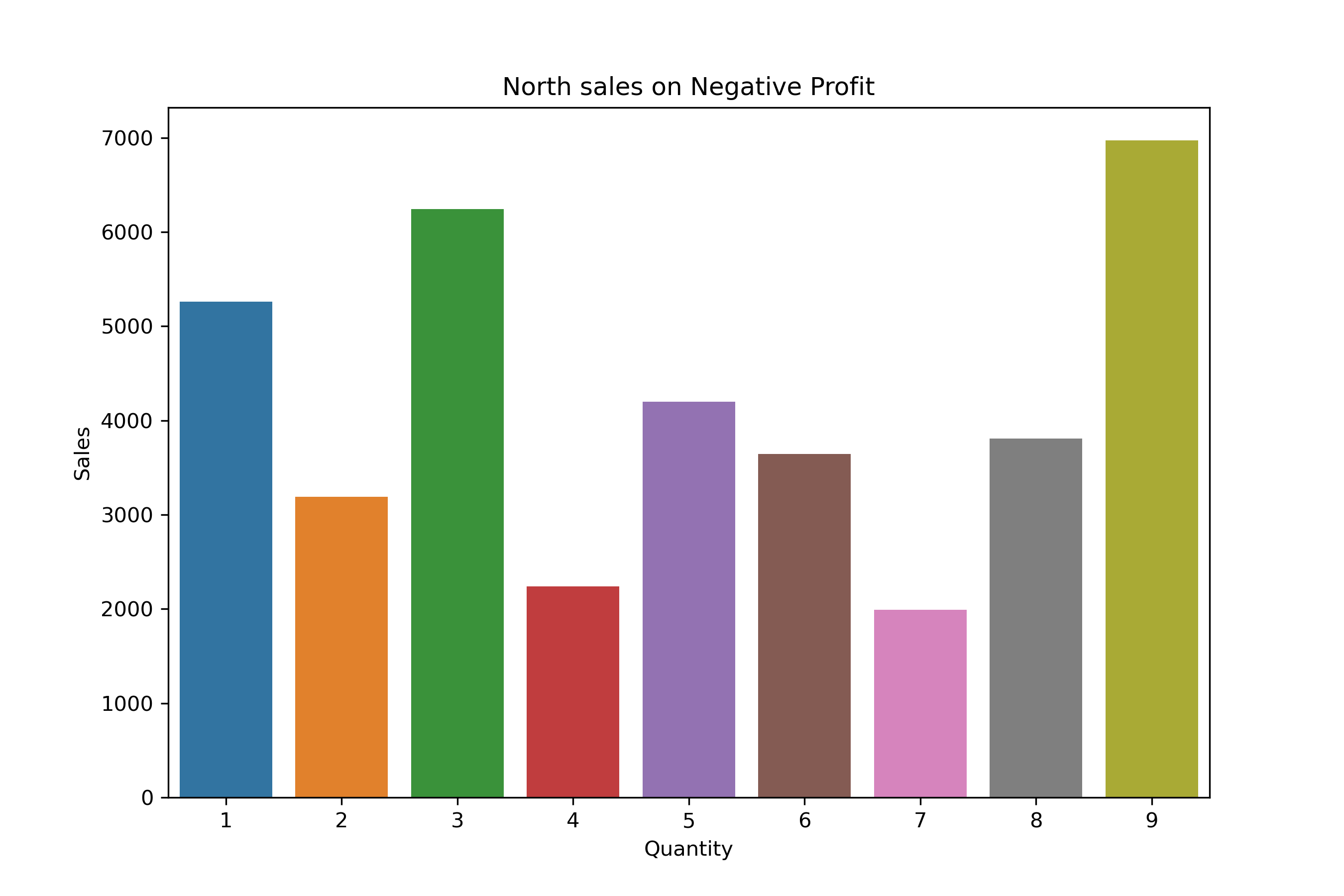
df_sales_West = df_neg_profit[df_neg_profit["Region"] == "West"].groupby("Quantity")["Sales"].sum()
df_sales_West
Quantity
1    6215.65
2    3118.75
3    6925.78
4    6878.59
5    6895.15
6    7319.91
7    4470.00
8    6783.22
9    3736.70
Name: Sales, dtype: float64
plt.figure(figsize = (9,6))
sns.barplot(x= df_sales_West.index, y= df_sales_West.values)
plt.title("West sales on Negative Profit")
plt.ylabel("Sales")
plt.show()
North Region Distribution:
df_profit_North = df_neg_profit[df_neg_profit["Region"] == "North"].groupby("Quantity")["Profit"].count()
df_profit_North
Quantity
1    13
2     6
3    14
4     5
5     7
6     9
7     6
8     9
9    11
Name: Profit, dtype: int64
df_profit_North = df_neg_profit[df_neg_profit["Region"] == "North"].groupby("Quantity")["Profit"].sum()
df_profit_North
Quantity
1   -764.34
2   -285.40
3   -730.11
4   -133.06
5   -623.66
6   -402.46
7   -162.61
8   -299.10
9   -827.33
Name: Profit, dtype: float64
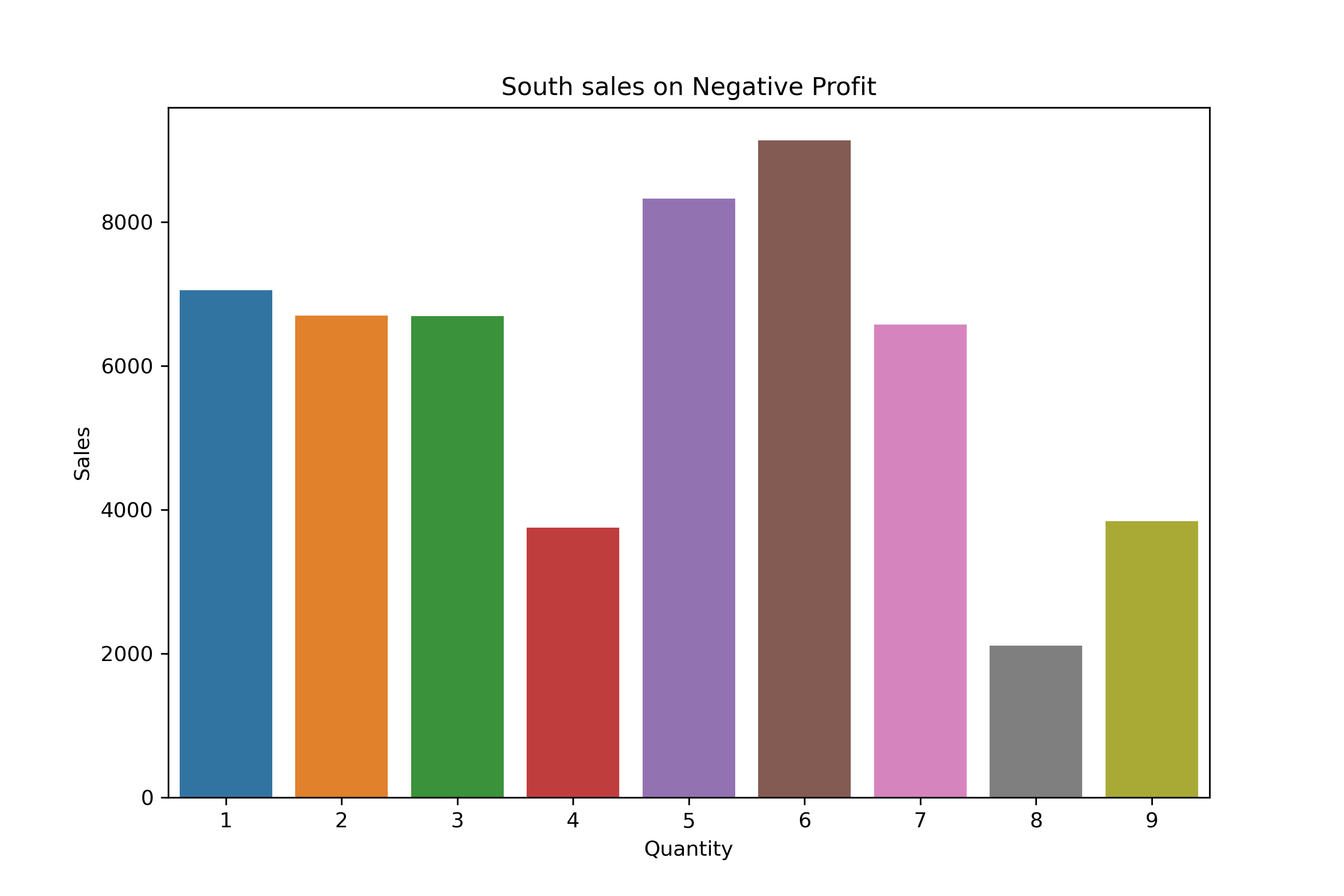
df_profit_North = df_neg_profit[df_neg_profit["Region"] == "North"].groupby("Quantity")["Sales"].sum()
df_profit_North
Quantity
1    5257.83
2    3190.53
3    6243.89
4    2241.93
5    4197.23
6    3641.99
7    1992.01
8    3807.97
9    6971.56
Name: Sales, dtype: float64
plt.figure(figsize = (9,6))
sns.barplot(x= df_profit_North.index, y= df_profit_North.values)
plt.title("North sales on Negative Profit")
plt.ylabel("Sales")
plt.show()
South Region Distribution:
df_profit_South = df_neg_profit[df_neg_profit["Region"] == "South"].groupby("Quantity")["Profit"].count()
df_profit_South
Quantity
1    12
2    12
3    10
4     9
5    14
6    16
7    12
8     4
9     6
Name: Profit, dtype: int64
df_profit_South = df_neg_profit[df_neg_profit["Region"] == "South"].groupby("Quantity")["Profit"].sum()
df_profit_South
Quantity
1    -620.22
2   -1058.33
3    -530.66
4    -270.70
5    -939.67
6   -1002.09
7    -538.92
8    -170.36
9    -184.64
Name: Profit, dtype: float64
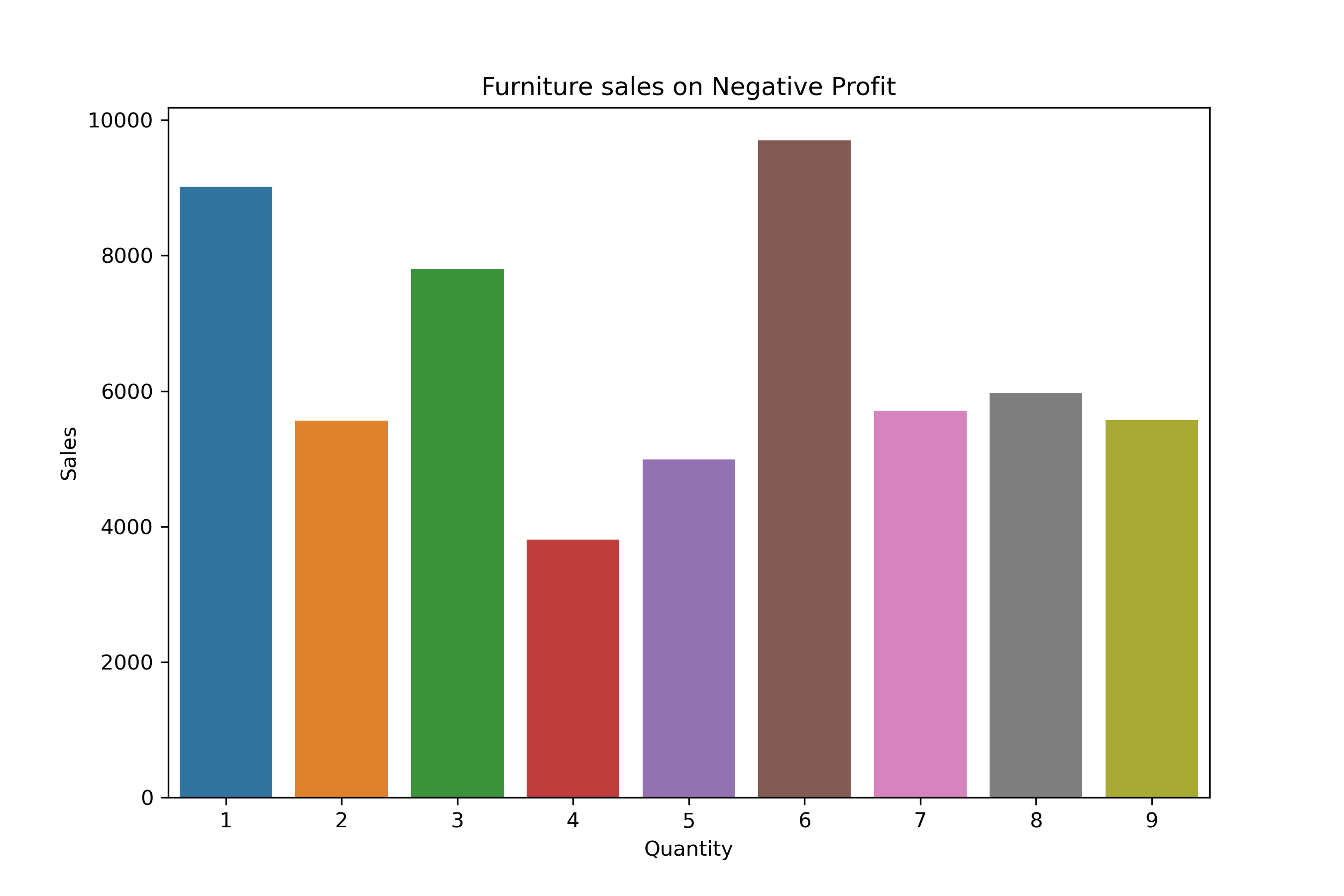
df_profit_South = df_neg_profit[df_neg_profit["Region"] == "South"].groupby("Quantity")["Sales"].sum()
df_profit_South
Quantity
1    7051.35
2    6696.42
3    6692.02
4    3748.86
5    8323.06
6    9131.71
7    6573.68
8    2112.23
9    3837.34
Name: Sales, dtype: float64
plt.figure(figsize = (9,6))
sns.barplot(x= df_profit_South.index, y= df_profit_South.values)
plt.title("South sales on Negative Profit")
plt.ylabel("Sales")
plt.show()
Overall Visualization:
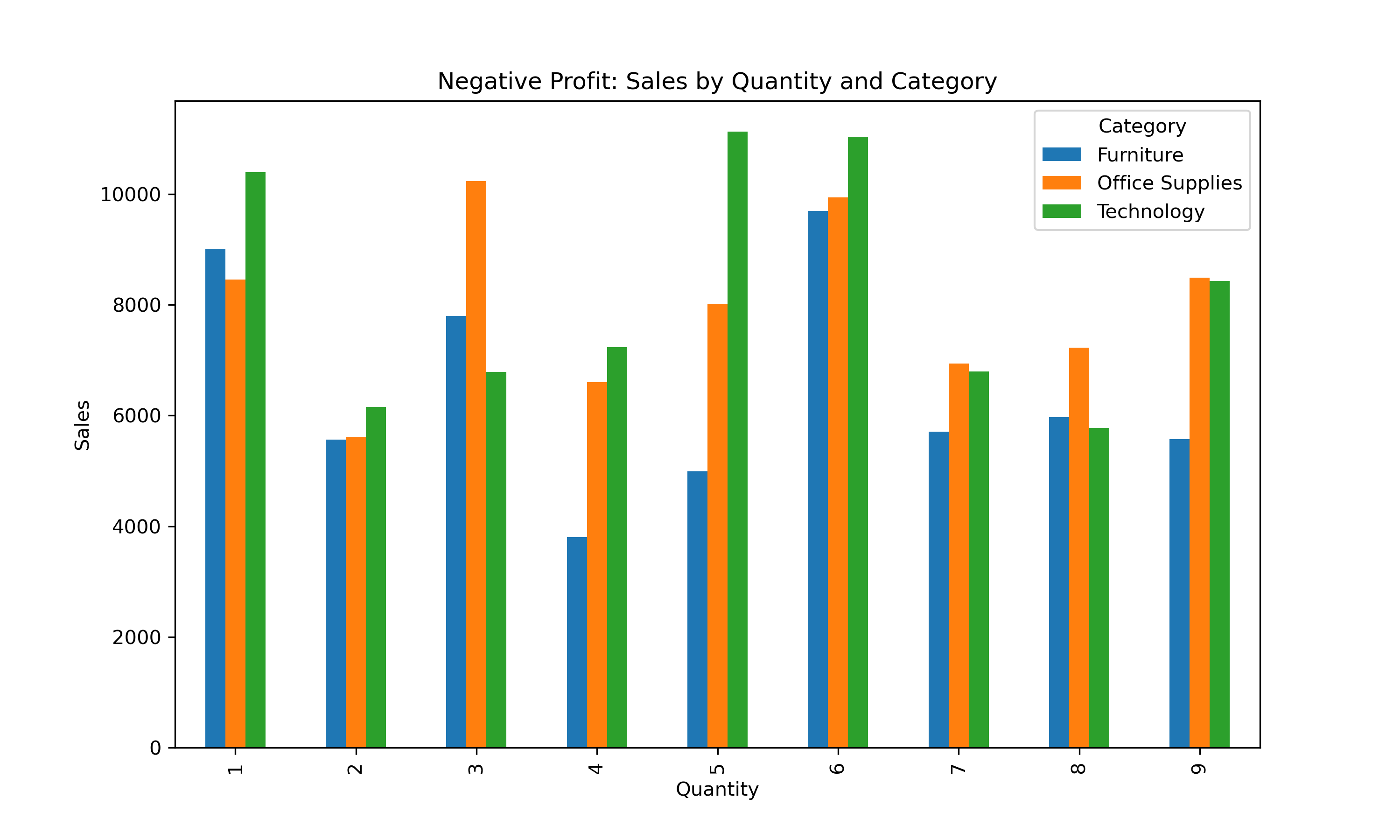
category_sales = df_neg_profit.pivot_table(index="Quantity", columns="Category", values="Sales", aggfunc="sum")
category_sales.plot(kind="bar", figsize=(10,6))
plt.title("Negative Profit: Sales by Quantity and Category")
plt.ylabel("Sales")
plt.show()
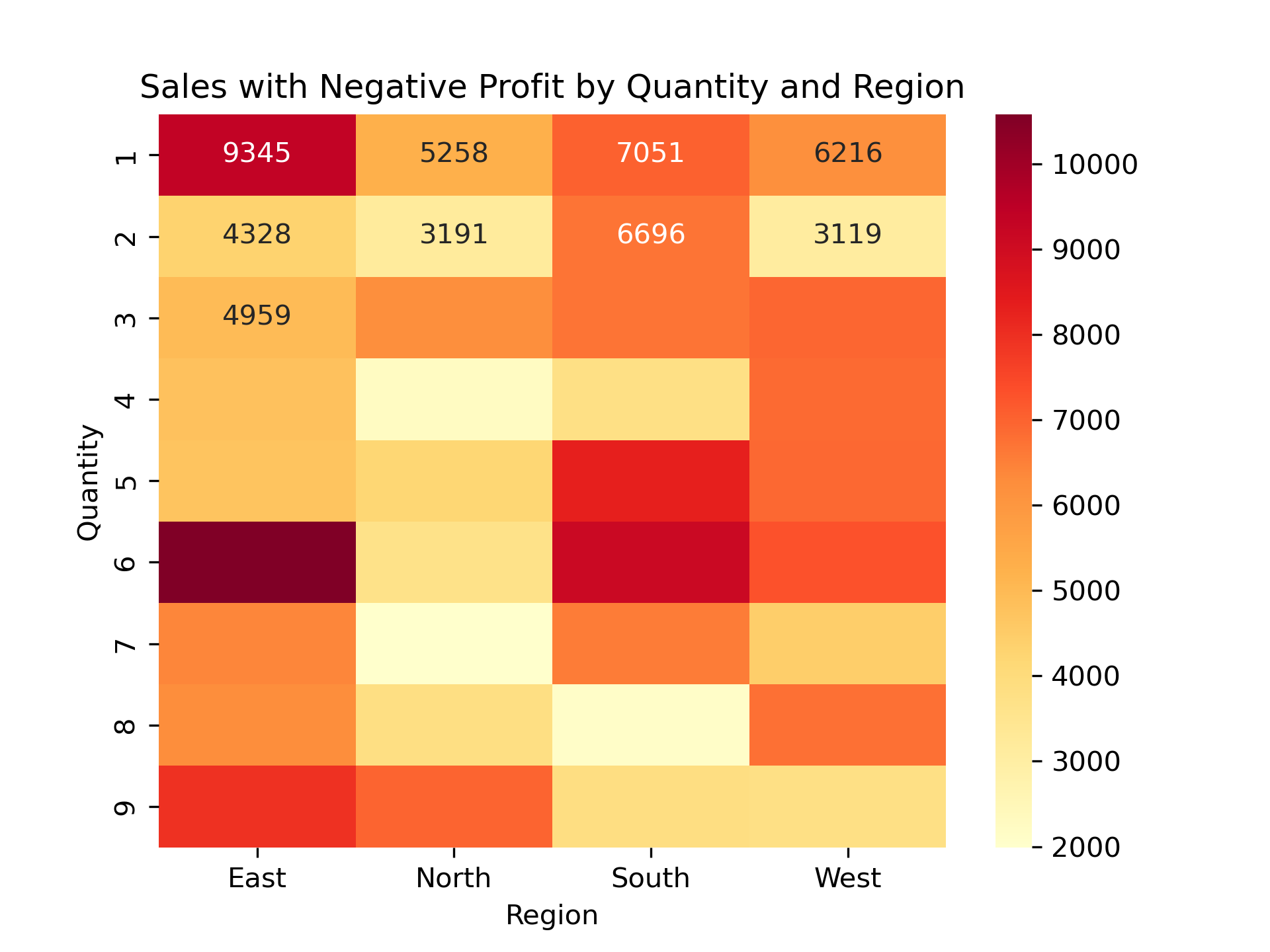
region_quantity = df_neg_profit.pivot_table(index="Quantity", columns="Region", values="Sales", aggfunc="sum")
sns.heatmap(region_quantity, annot=True, cmap="YlOrRd", fmt=".0f")
plt.title("Sales with Negative Profit by Quantity and Region")
plt.show()
Conclusion:
-
The same quantities — especially
1,3, and6units — are showing up again and again in loss-making orders. -
This happens in all product categories (Furniture, Office Supplies, Technology).
-
It also happens in all regions (East, West, North, South).
-
This tells us that small quantity orders, even when they have high sales, are still not profitable.
Q4. Optimizing Product Mix for Regions:
For each region, find the best-selling category by volume and the most profitable category. Are they the same? What does this imply?
df_product_mix = pd.DataFrame(df)
df_product_mix.head()
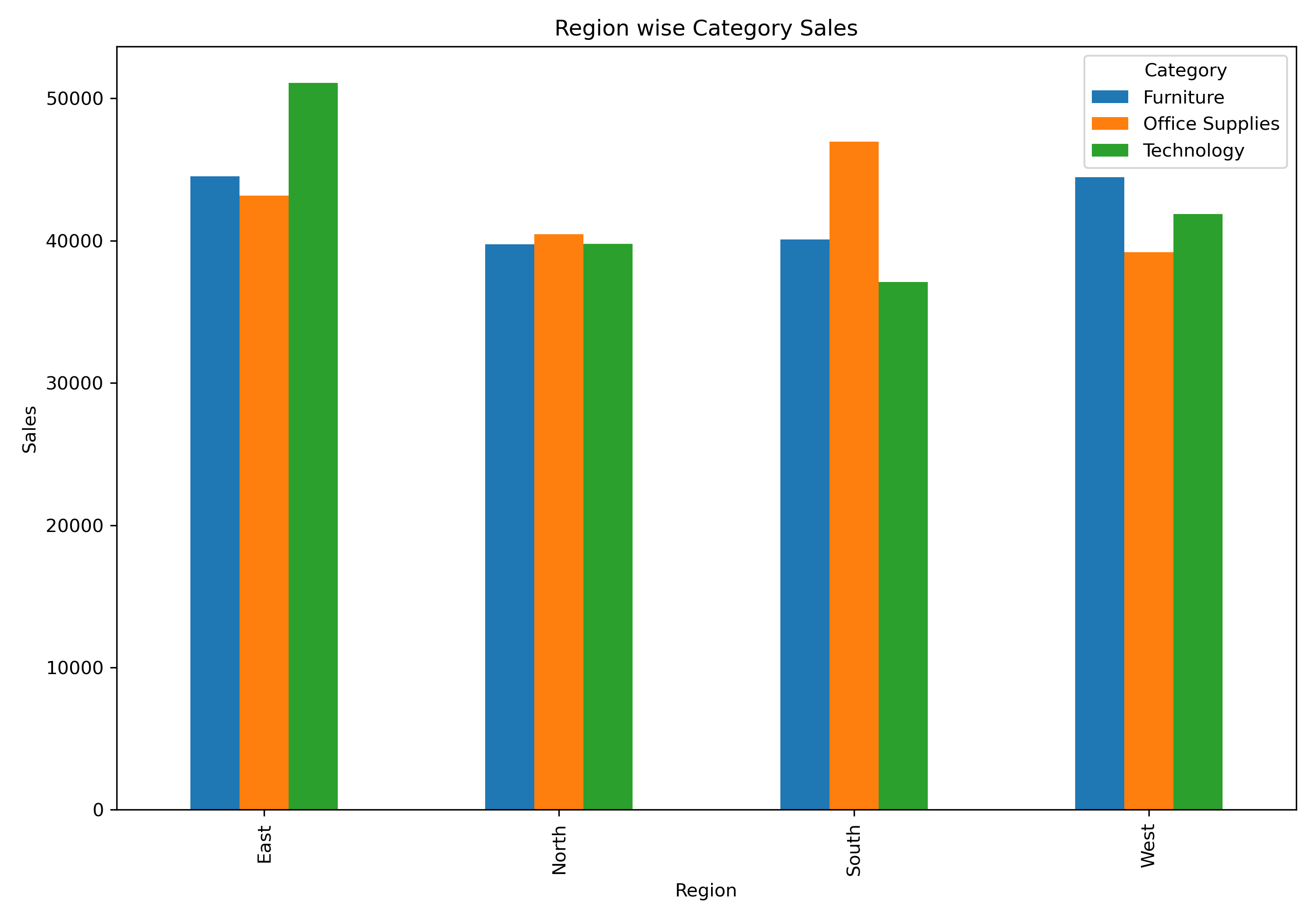
df_product_mix.groupby(["Region","Category"])["Sales"].sum()
Region  Category
East    Furniture          44515.40
        Office Supplies    43166.97
        Technology         51097.55
North   Furniture          39738.54
        Office Supplies    40463.24
        Technology         39787.34
South   Furniture          40073.94
        Office Supplies    46950.11
        Technology         37103.00
West    Furniture          44470.98
        Office Supplies    39181.65
        Technology         41876.95
Name: Sales, dtype: float64
df_sales = df_product_mix.pivot_table(index= "Region", columns= "Category", values= "Sales", aggfunc= "sum")
df_sales
df_sales.plot(kind= "bar", figsize= (10,7))
plt.title("Region wise Category Sales")
plt.ylabel("Sales")
plt.tight_layout()
plt.show()
df_profit = df_product_mix.pivot_table(index= "Region", columns= "Category", values= "Profit", aggfunc= "sum")
df_profit
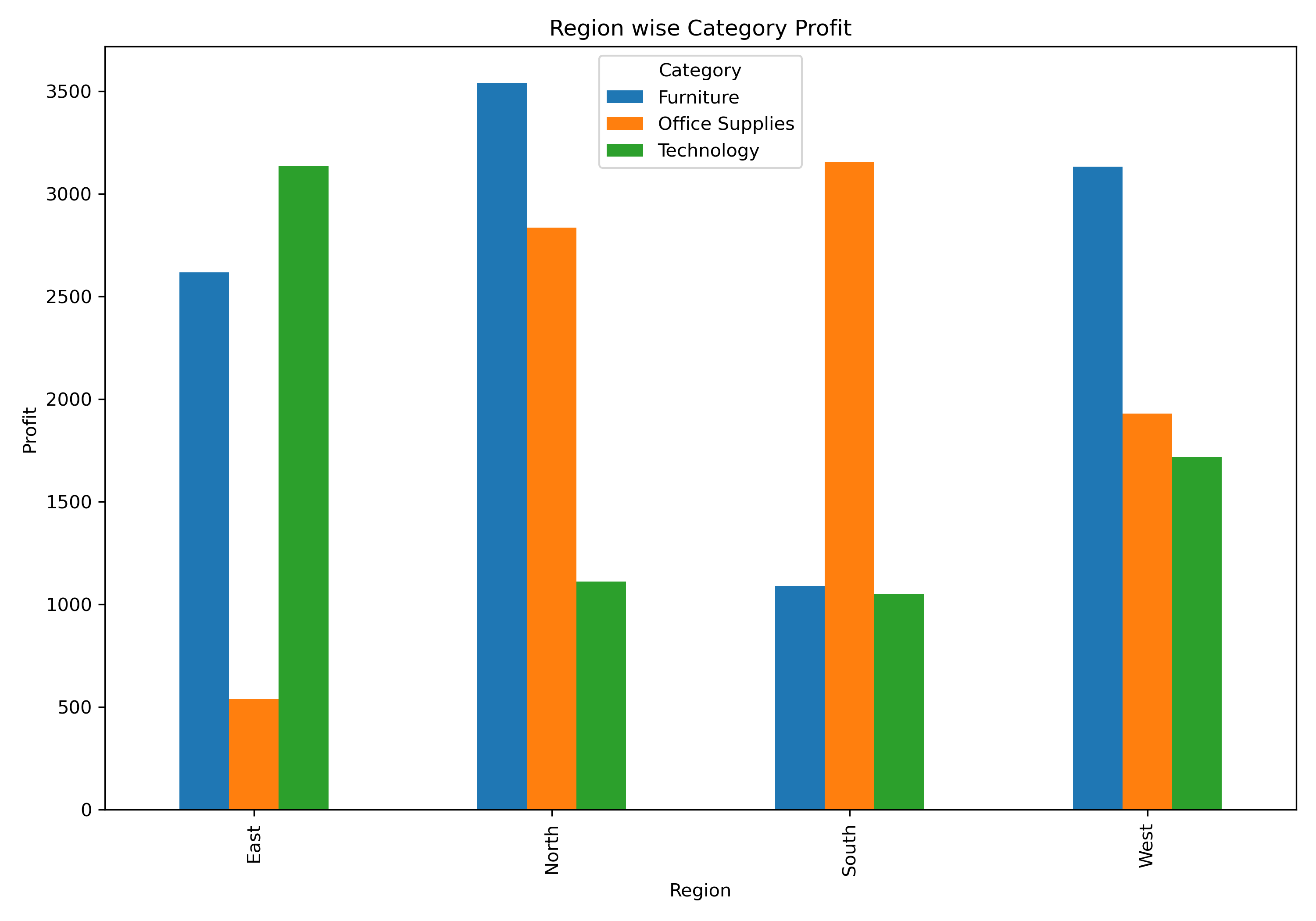
df_profit.plot(kind= "bar", figsize= (10,7))
plt.title("Region wise Category Profit")
plt.ylabel("Profit")
plt.tight_layout()
plt.show()
df_north_office = df_product_mix[(df_product_mix["Region"] == "North") & (df_product_mix["Category"] == "Office Supplies")]
df_north_office
df_north_neg = df_north_office[df_north_office["Profit"] < 0]
df_north_neg
office_positive_profit = df_north_office.groupby("Quantity")["Profit"].sum()
sum(office_positive_profit.values)
office_negative_profit = df_north_neg.groupby("Quantity")["Profit"].sum()
sum(office_negative_profit.values)
df_north_furniture = df_product_mix[(df_product_mix["Region"] == "North") & (df_product_mix["Category"] == "Furniture")]
df_north_furniture
df_north_fur_neg = df_north_office[df_north_office["Profit"] < 0]
df_north_fur_neg
Furniture_positive_profit = df_north_furniture.groupby("Quantity")["Profit"].sum()
sum(Furniture_positive_profit.values)
Furniture_negative_profit = df_north_fur_neg.groupby("Quantity")["Profit"].sum()
sum(Furniture_negative_profit.values)
Conclusion:
-
In the East, West, and South regions, the category with the highest sales also gave the highest profit. This shows that the current product mix in these regions is working well.
-
In the North region, Office Supplies had the highest sales, but Furniture made more profit.
-
Even though the sales difference between Office Supplies and Furniture was small (₹724), the profit difference was meaningful (₹705).
-
On deeper analysis, Office Supplies in North had more negative profit orders, while Furniture mostly made positive profits.
Q5. Demand Prediction Case:
Using historical data, identify if there is a trend or seasonal pattern in quantity sold for each product category over time.
df_trend_season = pd.DataFrame(df)
df_trend_season.head()
df_trend_season["Order Date"] = pd.to_datetime(df_trend_season["Order Date"])
df_trend_season["Year"] = df_trend_season["Order Date"].dt.year
df_trend_season["Month"] = df_trend_season["Order Date"].dt.month
df_trend_season["Year-Month"] = df_trend_season["Order Date"].dt.to_period("M")
monthly_trend = df_trend_season.groupby(['Year-Month', 'Category'])['Quantity'].sum().reset_index()
monthly_trend
pivot_df = monthly_trend.pivot(index='Year-Month', columns='Category', values='Quantity')
pivot_df
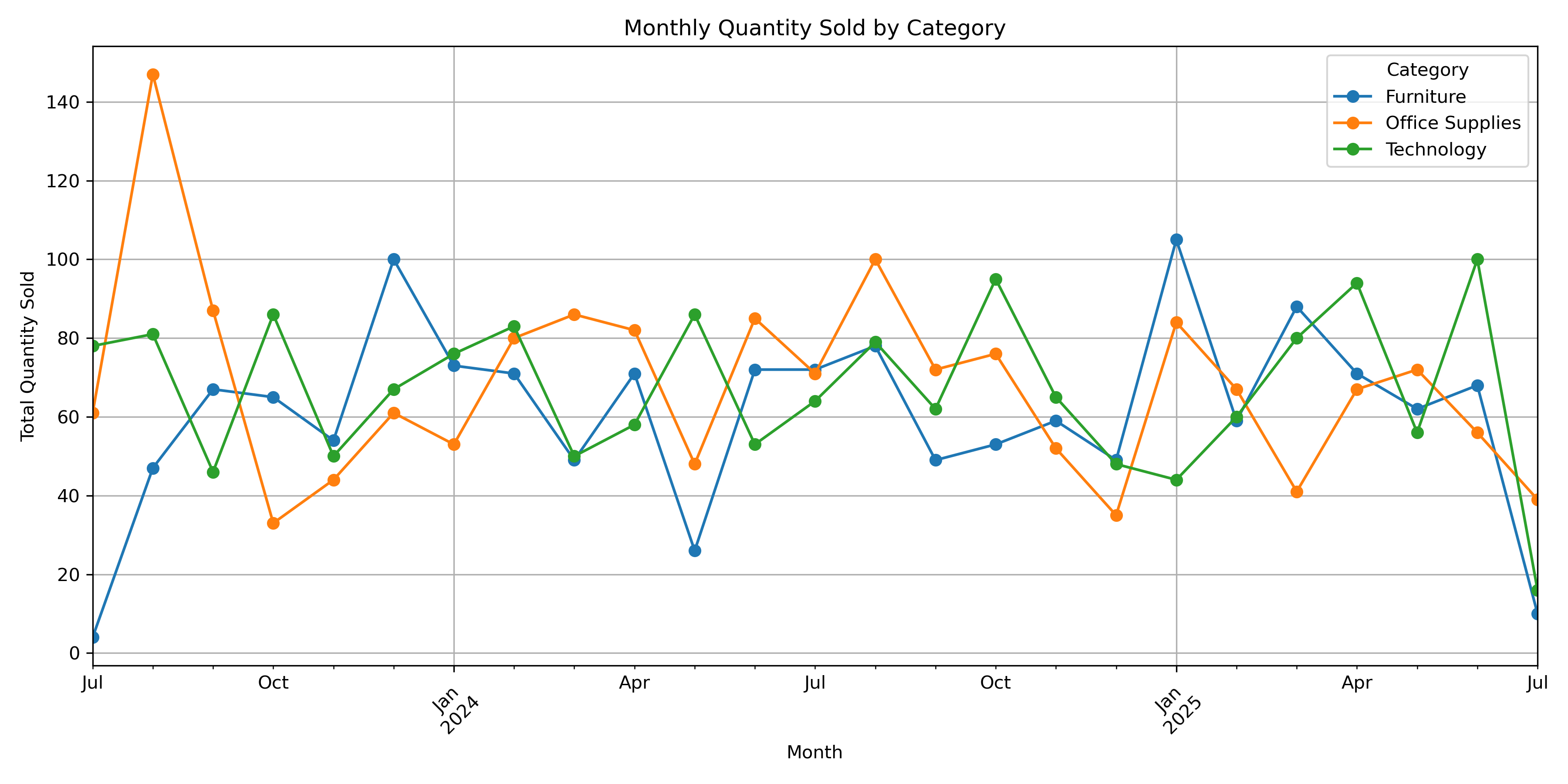
pivot_df.plot(figsize=(12,6), marker='o')
plt.title("Monthly Quantity Sold by Category")
plt.ylabel("Total Quantity Sold")
plt.xlabel("Month")
plt.xticks(rotation=45)
plt.grid(True)
plt.tight_layout()
plt.show()
Conclusion:
There is both a trend and seasonality present in the quantity sold over time:
-
Trends: Increasing demand (especially for Office Supplies).
-
Seasonality: Regular peaks at specific months across years.
Q6. Loss-Leading Product Investigation:
Find products or categories that have repeatedly shown negative profit despite high sales. Should they be discontinued or repriced?
df_high_sales = pd.DataFrame(df)
df_high_sales.head()
neg_profit = df_high_sales[df_high_sales["Profit"] < 0]
neg_profit
neg_profit.groupby("Category")["Sales"].sum()
Category
Furniture          58127.21
Office Supplies    71508.92
Technology         73748.27
Name: Sales, dtype: float64
neg_profit.groupby("Category")["Profit"].sum()
Category
Furniture         -6214.81
Office Supplies   -6843.83
Technology        -7364.55
Name: Profit, dtype: float64
tech_sort = neg_profit[neg_profit["Category"] == "Technology"]
tech_sort
tech_sort.groupby("Quantity").agg({
    "Quantity" : "count",
    "Sales" : "sum",
    "Profit" : "sum"
}).rename(columns= {"Quantity" : "Order_count"}).reset_index()
tot = tech_sort.groupby(["Quantity"])["Sales"].sum()
tot_sum = sum(tot)
per = (tot.values/tot_sum)*100
Conclusion:
-
The
Technologycategory accounts for the highest volume of negative-profit transactions, especially in quantity groups of1,5, and6units. -
These three quantity buckets alone contribute
45%of loss transactions, indicating that these sales are frequent and significant. -
Since these products are selling well (high sales count), it’s more financially sound to reprice them (increase unit price, reduce discount) rather than discontinue them.
Q7. Regional Sales Consistency:
Which region shows the most stable monthly sales performance over time? Use standard deviation or coefficient of variation to support your analysis.
df_std_cv = pd.DataFrame(df)
df_std_cv.head()
df_std_cv["Order Date"] = pd.to_datetime(df_std_cv["Order Date"])
df_std_cv["month_year"] = df_std_cv["Order Date"].dt.to_period("M")
monthly_sales = df_std_cv.groupby(["Region", "month_year"])["Sales"].sum().reset_index()
monthly_sales
region_sales = monthly_sales.groupby("Region")["Sales"].agg(["mean","std"]).reset_index()
region_sales
region_sales["cv"] = region_sales["std"] / region_sales["mean"]
region_sales.sort_values(by= "cv")
Conclusion:
-
Based on the coefficient of variation (CV) for monthly sales across regions, the North region has the most stable sales performance over time (CV = 0.36).
-
This indicates less fluctuation in monthly sales, making it the most consistent region in terms of sales.
Q8. Customer Retention Analysis:
Based on Customer ID, find the number of repeats vs. one-time customers. How does their average profit and sales differ?
df_customer = pd.DataFrame(df)
df_customer["Order Date"] = pd.to_datetime(df_customer["Order Date"])
df_customer.head()
customer_count = df_customer["Customer ID"].value_counts()
df_customer["customer_type"] = df_customer["Customer ID"].apply(lambda x : "repeat" if customer_count[x] > 1 else "one_time")
df_customer["customer_type"].value_counts()
customer_type
one_time    912
repeat       88
Name: count, dtype: int64 ```python customer_summary = df_customer.groupby("customer_type")[["Sales","Profit"]].sum() customer_summary ```
customer_summary["per_sales"] = round((customer_summary["Sales"]/ customer_summary["Sales"].sum())*100, 2)
customer_summary["per_profit"] = round((customer_summary["Profit"]/ customer_summary["Profit"].sum())*100, 2)
customer_summary
Conclusion:
-
Out of all customers, only a small portion are repeat customers, and they contribute ~9% of sales and ~10.5% of profit.
-
The majority of revenue is currently driven by one-time customers, showing a potential gap in customer retention.
-
There is no significant profitability difference between repeat and one-time buyers, indicating a possible opportunity to re-engage one-time buyers into becoming repeat customers.
Q9. Bulk Buying Patterns:
Are their specific cities or regions where customers consistently buy in higher quantities than average? What product categories are driving this?
df_cit_reg = pd.DataFrame(df)
region_agg = df_cit_reg.groupby("Region")[["Quantity"]].agg(["count","std","mean"]).reset_index()
region_agg["total_avg"] = df_cit_reg["Quantity"].mean()
a = df_cit_reg["City"].value_counts().reset_index()
a.columns = ["City", "count"]
b = a[a["count"] > 1]
city_filter = df_cit_reg[df_cit_reg["City"].isin(b["City"])]
city_agg = city_filter.groupby("City")[["Quantity"]].agg(["count","mean","std"]).reset_index()
city_agg["total_avg"] = df_cit_reg["Quantity"].mean()
Conclusion:
-
The East and West regions show slightly above-average bulk buying behavior, with mean quantities above the overall average
(4.898). -
Standard deviation across regions is relatively consistent, indicating stable purchasing patterns.
-
City-level analysis was inconclusive, as most cities appeared only once in the dataset and do not provide enough volume to draw meaningful conclusions.
Q10. Sales Efficiency Score:
Create a new metric: Profit per Unit Sold. Rank cities based on this efficiency. What actionable insights can Walmart take?
df_pro_per_unit = pd.DataFrame(df)
df_pro_per_unit.head()
df_city_cal = df_pro_per_unit.groupby("City")[["Quantity", "Profit"]].sum().reset_index()
df_city_cal.columns = ["City", "Quantity", "Profit"]
df_city_cal
df_city_cal["Per_unit"] = df_city_cal["Profit"] / df_city_cal["Quantity"]
df_city_cal
top_10_profit = df_city_cal.sort_values(by= "Per_unit", ascending= False).head(10)
top_10_profit
bottom_10_profit = df_city_cal.sort_values(by= "Per_unit").head(10)
bottom_10_profit
Conclusion:
A new metric, Profit per Unit Sold, was created to evaluate the sales efficiency of each city.
-
The top 10 cities generate high profit per unit, indicating strong product mix or premium customer segments.
-
The bottom 10 cities show low or negative efficiency, possibly due to high volume of low-margin items or higher return rates.
Actionable insights for Walmart:
-
Focus on expanding profitable categories in high-efficiency cities.
-
In low-efficiency cities, re-evaluate pricing, optimize product assortment, or address operational inefficiencies.
Q11. Sales Efficiency Score:
Is there a negative correlation between quantity sold and profit per unit in any region or category? What does this suggest?
df_neg_reg = pd.DataFrame(df)
region_regg = df_neg_reg.groupby("Region")[["Quantity","Profit"]].sum().reset_index()
region_regg.columns = ["Region", "Quantity", "Profit"]
region_regg["Per_Unit"] = region_regg["Profit"] / region_regg["Quantity"]
region_regg
a = region_regg.drop("Region", axis= 1)
region_cor = a.corr()
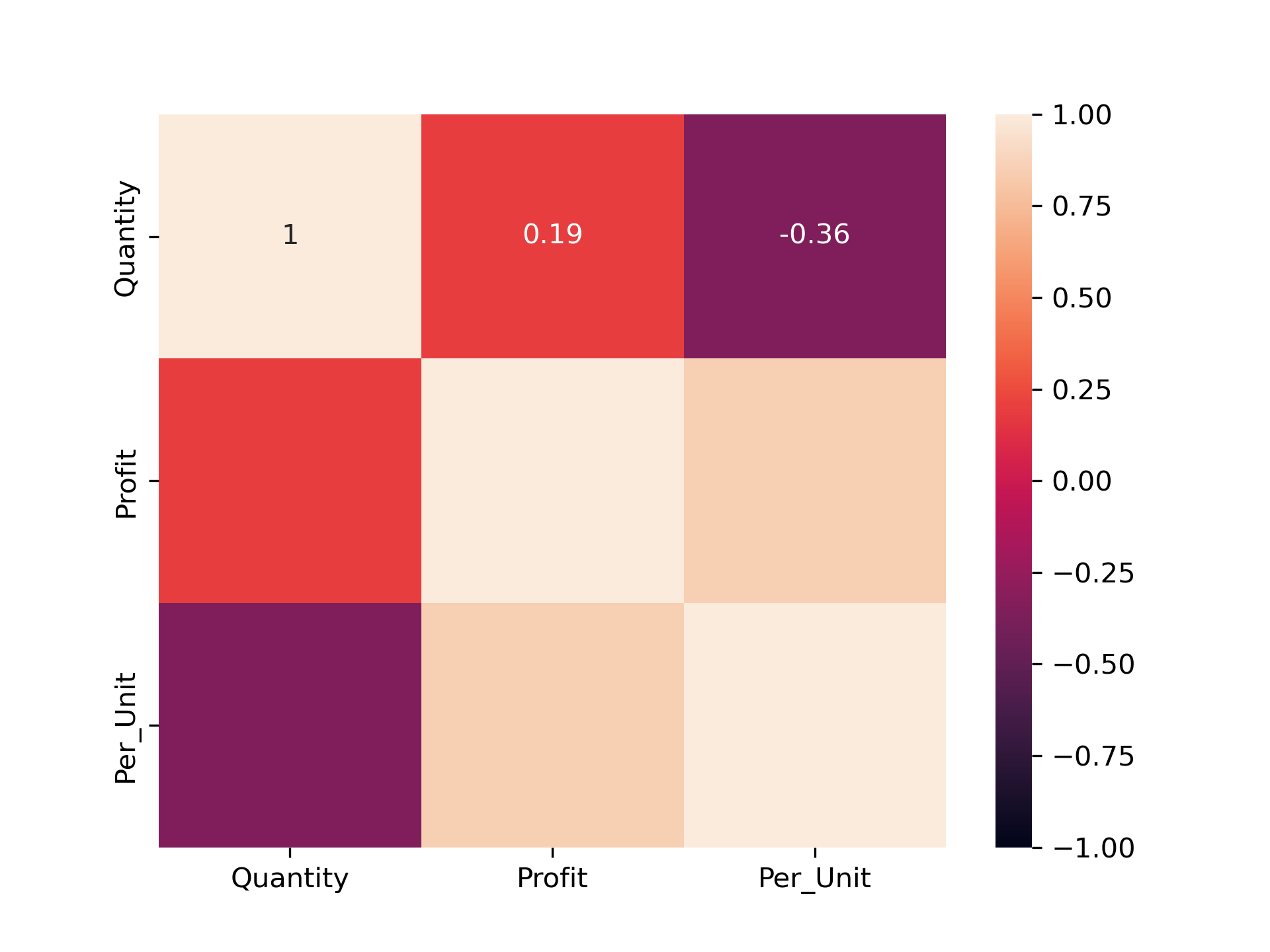
sns.heatmap(region_cor,vmin= -1, vmax= 1 ,annot= True)
plt.show()
cat_regg = df_neg_reg.groupby("Category")[["Quantity","Profit"]].sum().reset_index()
cat_regg.columns = ["Category", "Quantity", "Profit"]
cat_regg["Per_Unit"] = cat_regg["Profit"] / cat_regg["Quantity"]
cat_regg
b = cat_regg.drop("Category", axis= 1)
cat_cor = b.corr()
sns.heatmap(cat_cor,vmin= -1, vmax= 1 ,annot= True)
plt.show()
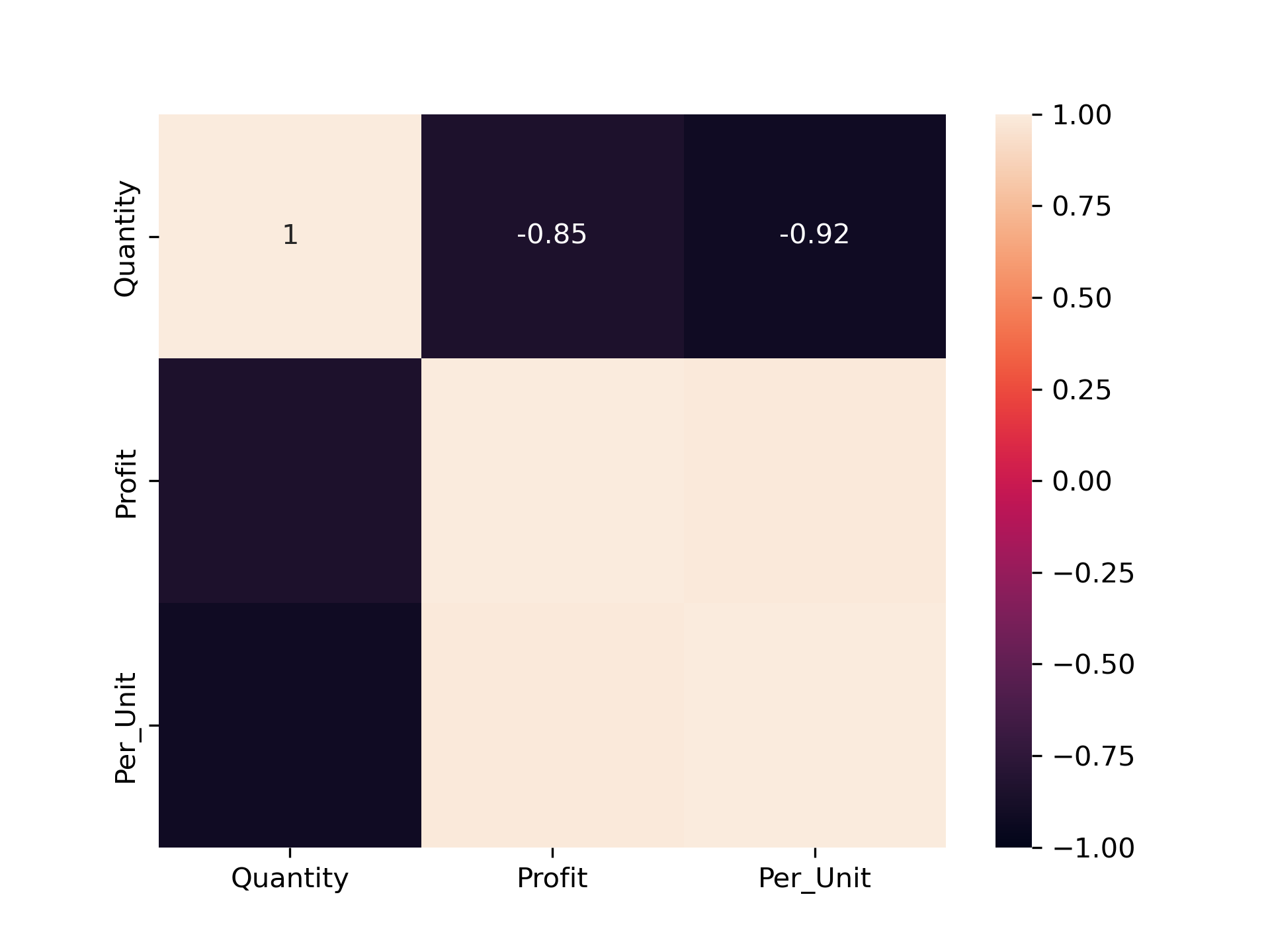
Conclusion:
-
According to the region segment – Yes negative correlation between quantity sold and profit per unit is occurring and negative correlation value =
-0.36. -
According to the Category segment – Yes negative correlation between quantity sold and profit per unit is occurring and Occurring negative correlation value =
-0.92.
Q12. Campaign Impact Simulation:
Assume Walmart ran a 10% discount campaign in August 2024. Recalculate profit for that month and evaluate how the campaign would have affected overall profitability.
df_aug_10 = pd.DataFrame(df)
df_aug_10.head()
df_extract_aug = df_aug_10[(df_aug_10["Order Date"] >= "2024-08-01") & (df_aug_10["Order Date"] <= "2024-08-31")]
df_extract_aug.reset_index().head()
august_10_per = df_extract_aug["Profit"] - (df_extract_aug["Profit"] / 100) * 10
august_10_per.head()
seperate_aug = df_aug_10["Profit"].sum() - df_extract_aug["Profit"].sum()
seperate_aug
overall_10_profit = seperate_aug + august_10_per.sum()
overall_10_profit
without_dis = round(df_aug_10["Profit"].sum() / df_aug_10["Profit"].count(), 2)
without_dis
with_10_dis = round(overall_10_profit / df_aug_10["Profit"].count(), 2)
with_10_dis
Conclusion:
Before 10% discount: ₹25.86 profit/order
After discount: ₹25.78 profit/order
Impact = only ₹0.08 difference
-
This indicates that Walmart can safely run such discount campaigns without significantly harming profitability.
-
If the discount leads to even a small boost in sales volume, the overall profit may actually increase.
Q13. Return Risk Zones:
If high-quantity orders with low profit are considered risky for returns, which region shows the highest risk exposure?
df_return_risk = pd.DataFrame(df)
df_return_risk.groupby(["Region", "Quantity"])[["Quantity", "Profit"]].sum()
sep_east = df_return_risk[(df_return_risk["Region"] == "East") & (df_return_risk["Quantity"] == 9)]
q_east = sep_east["Quantity"].sum()
p_east = sep_east["Profit"].sum()
sep_east = df_return_risk[(df_return_risk["Region"] == "South") & (df_return_risk["Quantity"] == 9)]
q_south = sep_east["Quantity"].sum()
p_south = sep_east["Profit"].sum()
sep_east = df_return_risk[(df_return_risk["Region"] == "North") & (df_return_risk["Quantity"] == 8)]
q_north = sep_east["Quantity"].sum()
p_north = sep_east["Profit"].sum()
sep_east = df_return_risk[(df_return_risk["Region"] == "West") & (df_return_risk["Quantity"] == 8)]
q_west = sep_east["Quantity"].sum()
p_west = sep_east["Profit"].sum()
join = pd.DataFrame({
    "Quantity_count" : [q_east, q_south, q_north, q_west],
    "Profit_sum" : [p_east, p_south, p_north, p_west]
             }, index= ["east", "south", "north", "west"])
join["Profit_perc"] = (join["Profit_sum"] / join["Profit_sum"].sum()) * 100
join
Conclusion:
Based on the Region segmentation East region has Quantity count is 270, total profit is 289.05, and percentage is 11.09% contribution.
-
East has high quantity but very low profit, so it is most at risk.
Q14. Return Risk Zones:
Calculate how many days (based on order date) it took each region to cross a cumulative profit of ₹5,000. Who was fastest?
df_time = df.copy()
df_time.head()
filter_1 = df_time.groupby(["Region", "Order Date"])["Profit"].sum().reset_index()
filter_1 = filter_1.sort_values(["Region", "Order Date"])
filter_1["cumsum"] = filter_1.groupby("Region")["Profit"].cumsum()
filter_2 = filter_1[filter_1["cumsum"] > 1000]
filter_2 = filter_2.groupby("Region")["Order Date"].first().reset_index()
filter_2.columns = ["Region", "Last_day"]
filter_2
filter_3 = df_time.groupby(["Region"])["Order Date"].min().reset_index()
filter_3.columns = ["Region", "First_day"]
filter_3
day_count = pd.merge(filter_2, filter_3, on= "Region")
day_count["Day_counts"] = day_count["Last_day"] - day_count["First_day"]
day_count
Conclusion:
-
Based The South Region was the fastest to reach ₹1,000 profit in just 34 days from their first order date.
-
This shows stronger early sales momentum or better margins in that region.
Q15. High-Impact Customer Recovery Plan:
Identify the bottom 5% of customers by profit. Suggest a personalized sales strategy for them based on their past order behaviour.
df_bottom = df.copy()
df_filter = df_bottom.groupby(["Customer ID"])["Profit"].sum().reset_index()
df_filter = df_fil.sort_values(by= "Profit")
df_fill_5 = round((df_filter["Profit"].count()/100)*5)
bottom_5 = df_filter.head(df_fill_5)
filtered_bottom_5 = df_bottom[df_bottom["Customer ID"].isin(bottom_5["Customer ID"])]
analysis_bottom = filtered_bottom_5.groupby("Quantity")[["Quantity","Sales","Profit"]].sum()
analysis_bottom.columns = ["Quantity_counts", "Sales", "Profit"]
analysis_bottom.reset_index()
analysis_bottom["Quantity_per"] = round((analysis_bottom["Quantity_counts"] / analysis_bottom["Quantity_counts"].sum())*100)
analysis_bottom["Sales_per"] = round((analysis_bottom["Sales"] / analysis_bottom["Sales"].sum())*100)
analysis_bottom["Profit_per"] = round((analysis_bottom["Profit"] / analysis_bottom["Profit"].sum())*100)
analysis_bottom
Conclusion:
All 48 customers in the bottom 5% are one-time customers.
High-quantity buyers (Qty > 4) among them are responsible for:
-
80% of Quantity
-
60% of Sales
-
56% of (Negative) Profit
These may be discount-driven buyers → suggesting repricing to improve profit.
🛒 Walmart Sales EDA(Exploratory Data Analysis) - Project Documentation: