01_Walmart_Null_Values_Handling_Overall
🛒 Walmart Null Value Handling - Full Project Journal
Handling Null Values in Different Columns
Objective :
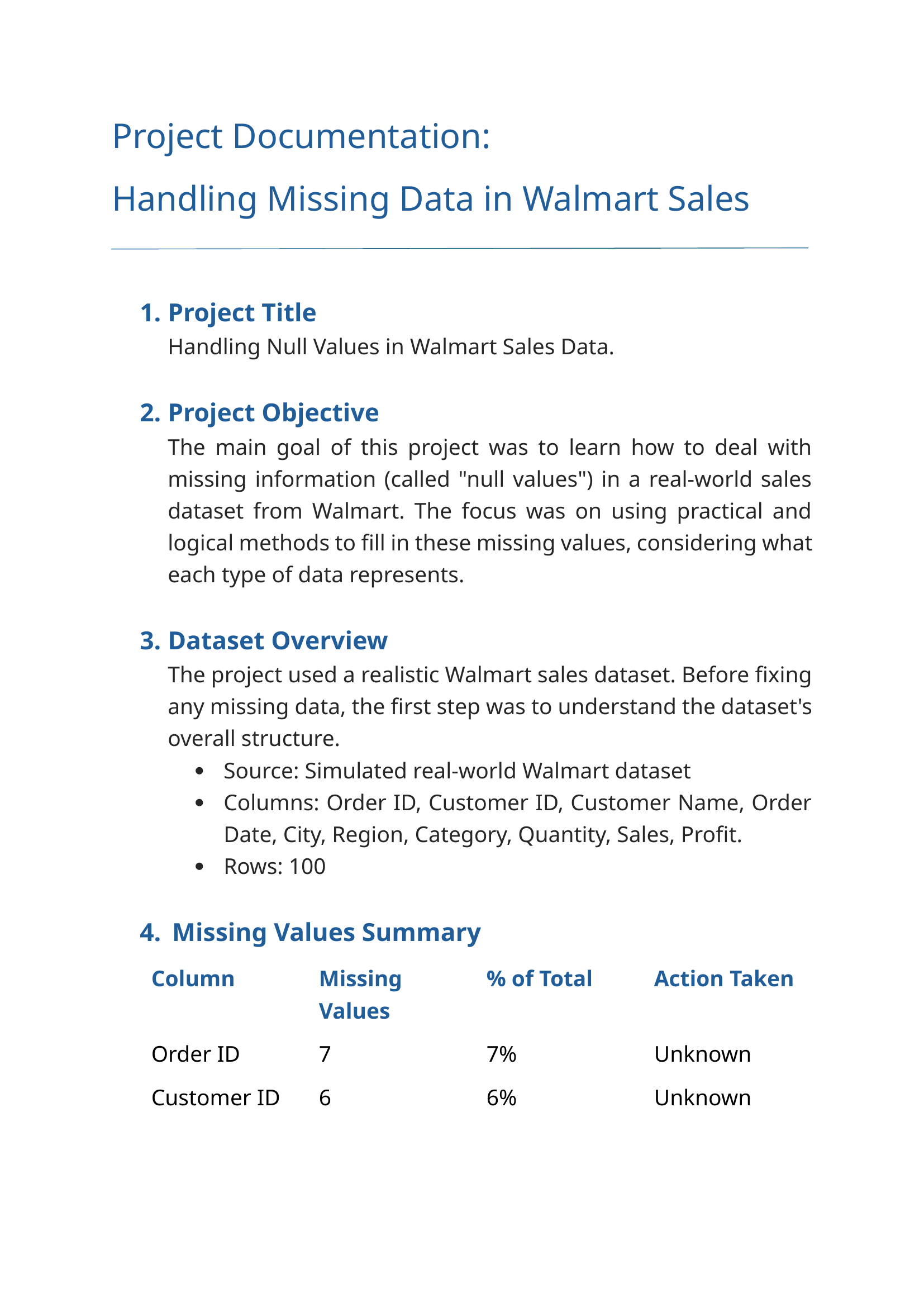
This is a realistic Walmart sales dataset. In this project, I aim to handle the missing (null) values using practical, real-world logic based on the type and context of each column.
Part 1:
-
Import the necessary libraries and dataset, then analyze the structure and quality of the data.
Part 2:
-
Apply appropriate real-world logic to impute.
Part 3:
-
Plot the chart before and after handling null values, Final summary.
PART - 1
Import the librarys and Dataset :
import numpy as np
import pandas as pd
import matplotlib.pyplot as plt
import seaborn as sns
df = pd.read_csv(r"D:\B_Data_Anlysist_Project\Python_Projects\01_Handling_Null_Value\walmart_sales_with_nulls_value_dataset.csv")
df.head()
df.shape
df.info()
df.isnull().sum()
Dataset Analysis :
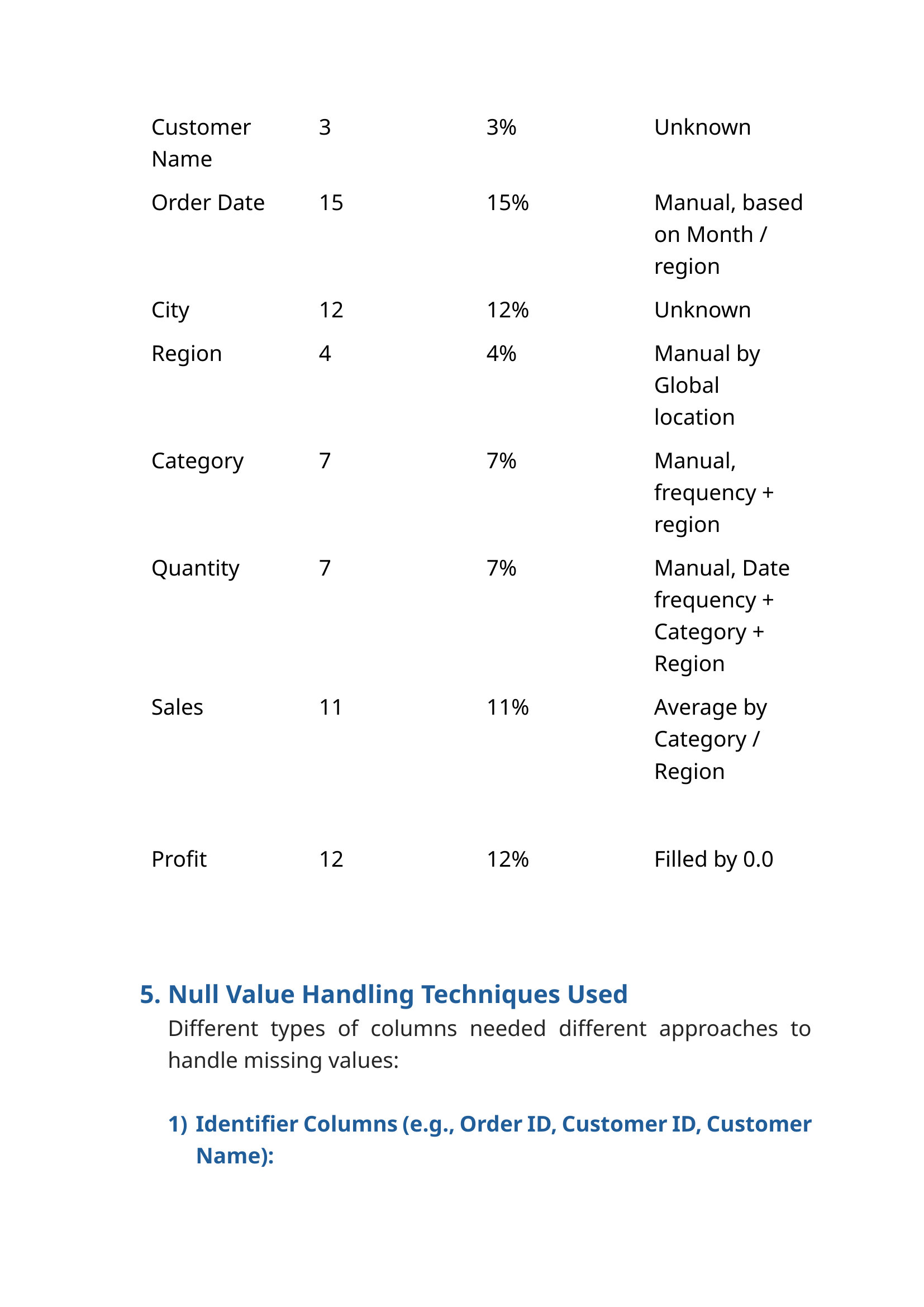
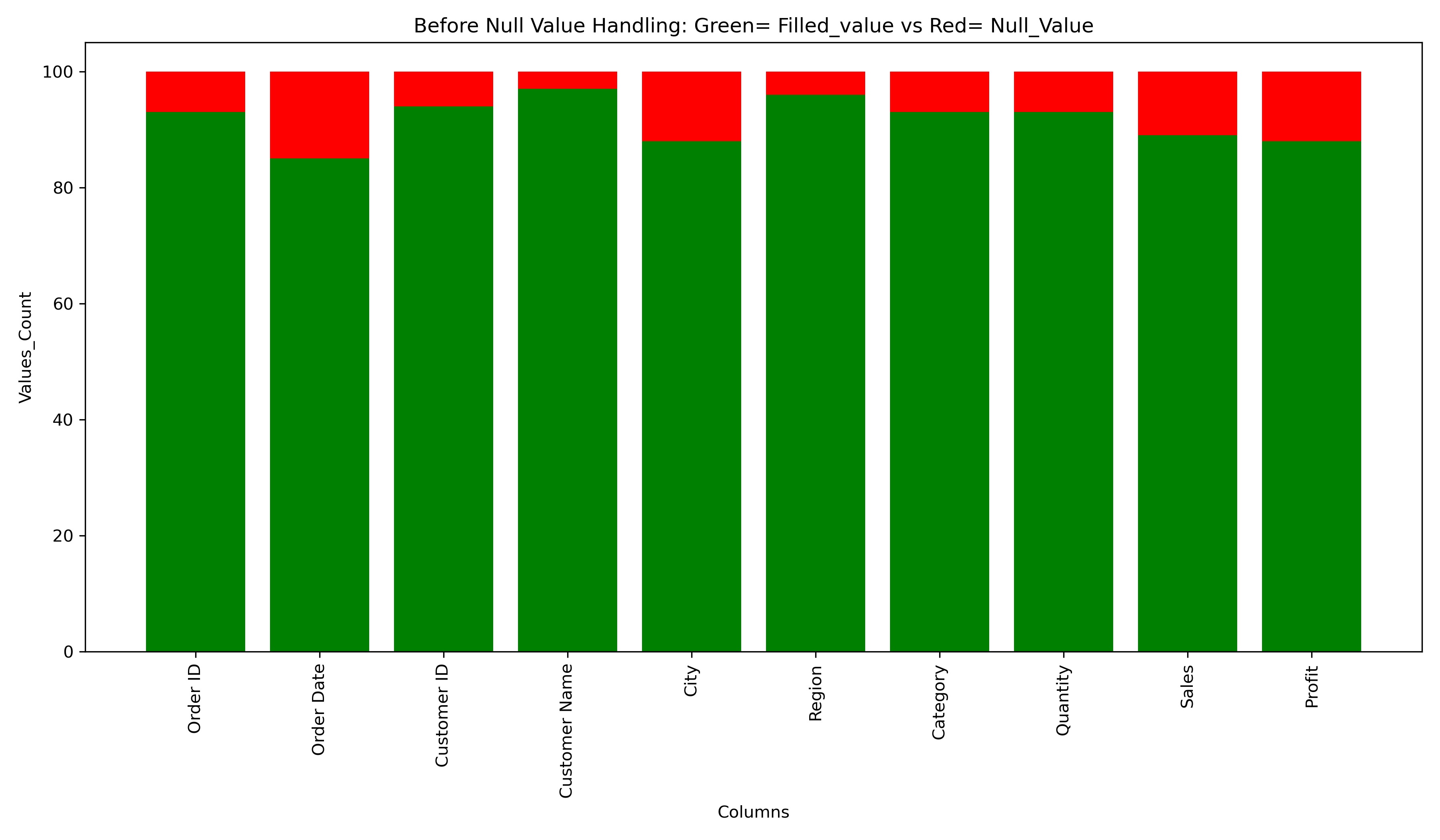
The dataset contains 10 columns and 100 rows. Based on the data types and usage, I’ve categorized the columns into 4 types:
-
Identifiers columns :
-
Order ID - 93 filled values & 7 null values,
-
Customer ID - 94 filled values & 6 null values,
-
Customer Name - 97 filled values & 3 null values.
-
-
Dates columns :
-
Order Date - 85 filled values & 15 null values.
-
-
Categorical columns :
-
City - 88 filled values & 12 null values,
-
Region - 96 filled values & 4 null values,
-
Categor - 93 filled values & 7 null values.
-
-
Numerical columns :
-
Quantity - 93 filled values & 7 null values,
-
Sales - 89 filled values & 11 null values,
-
Profit - 88 filled values & 12 null values.
-
PART - 2
1 - Handling the Identifiers columns :
df_copy = pd.DataFrame(df)
df_copy.head()
1 - Handling the Order ID column :
-
Type: Object
-
Fill_values: 93
-
Null_values: 7
df_copy["Order ID"].info()
df_copy["Order ID"].isnull().sum()
df_copy[df_copy["Order ID"].isnull()]
df_copy["Order ID"] = df_copy["Order ID"].fillna("Unknown")
df_copy[df_copy["Order ID"] == "Unknown"]
Order ID column Analysis :
Step - 1 :
I am looking for any same order id is there in the column. All 93 order are having a unique id.
Step - 2 :
Placing every order create unique Order ID. So, there is no possible to relate with any columns to fill the relative data for the missing value.
Conclusion :
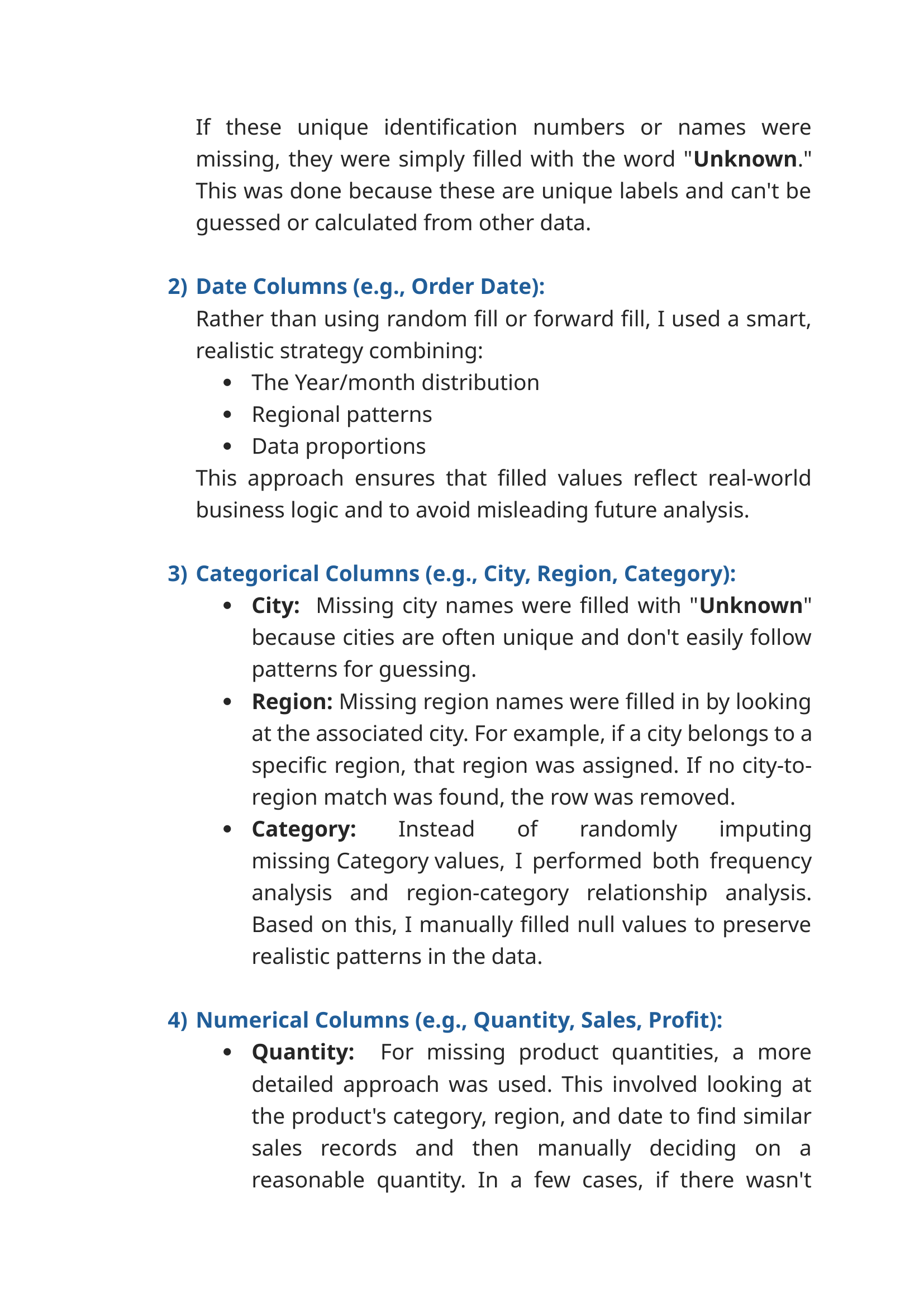
Since the Order IDs are unique and there’s no meaningful logic to derive the missing values from other columns, I have filled the null values with the placeholder "Unknown" to retain row integrity without creating misleading data.
df_copy["Order ID"].info()
2 - Handling the Customer ID column :
-
Type: Object
-
Fill_values: 94
-
Null_values: 6
df_copy["Customer ID"].nunique()
df_copy["Customer ID"].info()
df_copy[df_copy["Customer ID"].isnull()]
df_copy["Customer ID"] = df_copy["Customer ID"].fillna("Unknown")
df_copy[df_copy["Customer ID"] == "Unknown"]
Customer ID column Analysis :
Step - 1 :
Checked for duplicate or repeated customer IDs to see if any customers placed multiple orders.
Result: All 94 customer IDs are unique.
Conclusion :
Since each customer is unique, there is no way to infer the missing values from other rows or columns. Therefore, I filled the null values with the placeholder "Unknown" to retain row integrity without creating misleading assumptions.
df_copy["Customer ID"].info()
3 - Handling the Customer Name column :
-
Type: Object
-
Fill_values: 97
-
Null_values: 3
df_copy["Customer Name"].nunique()
df_copy["Customer Name"].info()
df_copy[df_copy["Customer Name"].isnull()]
df_copy["Customer Name"] = df_copy["Customer Name"].fillna("Unknown")
df_copy[df_copy["Customer Name"] == "Unknown"]
Customer Name column Analysis :
Step - 1 :
Checked for duplicate or repeated customer names to see if any customers placed multiple orders.
Result: All 97 customer names are unique.
Step - 2 :
Tried to relate Customer Name with Customer ID, but since all Customer IDs are also unique (except 6 missing), no reliable grouping or mapping is possible.
Conclusion :
As all customer names are unique and cannot be related to other identifiers, I filled the null values with the placeholder “Unknown” to preserve data consistency.
Why i did not use Forward Fill :
While forward fill is a valid approach, it can cause misleading data in this case.
df_copy["Customer Name"].info()
df_copy[["Order ID", "Customer ID", "Customer Name"]].info()
2 - Handling the Dates columns :
df_date = pd.DataFrame(df_copy)
df_date.head()
1 - Handling the Order Date column :
-
Type: Object
-
Fill_values: 85
-
Null_values: 15
df_date["Order Date"] = pd.to_datetime(df_date["Order Date"], dayfirst= True)
df_date.head()
df_date["Year"] = df_date["Order Date"].dt.year
df_date.head()
df_date["Month"] = df_date["Order Date"].dt.month
df_date.head()
df_date[(df_date["Year"] == 2023) & (df_date["Month"] == 7)].count()
df_date[(df_date["Year"] == 2023) & (df_date["Month"] == 8)].count()
df_date[(df_date["Year"] == 2023) & (df_date["Month"] == 9)].count()
df_date[(df_date["Year"] == 2023) & (df_date["Month"] == 10)].count()
df_date[(df_date["Year"] == 2023) & (df_date["Month"] == 11)].count()
df_date[(df_date["Year"] == 2023) & (df_date["Month"] == 12)].count()
df_date[(df_date["Year"] == 2024) & (df_date["Month"] == 1)].count()
df_date[(df_date["Year"] == 2024) & (df_date["Month"] == 2)].count()
df_date[(df_date["Year"] == 2024) & (df_date["Month"] == 3)].count()
df_date[(df_date["Year"] == 2024) & (df_date["Month"] == 4)].count()
df_date[(df_date["Year"] == 2024) & (df_date["Month"] == 5)].count()
df_date[(df_date["Year"] == 2024) & (df_date["Month"] == 6)].count()
df_date[(df_date["Year"] == 2024) & (df_date["Month"] == 7)].count()
df_date[(df_date["Year"] == 2024) & (df_date["Month"] == 8)].count()
df_date[(df_date["Year"] == 2024) & (df_date["Month"] == 9)].count()
df_date[(df_date["Year"] == 2024) & (df_date["Month"] == 10)].count()
df_date[(df_date["Year"] == 2024) & (df_date["Month"] == 11)].count()
df_date[(df_date["Year"] == 2024) & (df_date["Month"] == 12)].count()
df_date[(df_date["Year"] == 2025) & (df_date["Month"] == 1)].count()
df_date[(df_date["Year"] == 2025) & (df_date["Month"] == 2)].count()
df_date[(df_date["Year"] == 2025) & (df_date["Month"] == 3)].count()
df_date[(df_date["Year"] == 2025) & (df_date["Month"] == 4)].count()
df_date[(df_date["Year"] == 2025) & (df_date["Month"] == 5)].count()
df_date[(df_date["Year"] == 2025) & (df_date["Month"] == 6)].count()
df_per = df_date.groupby("Year").agg({"Month" : "count"})/df_date["Year"].count()*100
round(df_per)
df_date[df_date["Order Date"].isnull()]
df_date.at[6, "Order Date"] = "01-01-2024"
df_date.at[89, "Order Date"] = "20-04-2024"
df_date.at[10, "Order Date"] = "15-02-2024"
df_date.at[74, "Order Date"] = "12-11-2024"
df_date.at[12, "Order Date"] = "16-12-2024"
df_date.at[45, "Order Date"] = "11-04-2024"
df_date.at[43, "Order Date"] = "23-09-2024"
df_date.at[62, "Order Date"] = "01-10-2024"
df_date.at[19, "Order Date"] = "30-08-2023"
df_date.at[26, "Order Date"] = "13-07-2023"
df_date.at[36, "Order Date"] = "28-10-2023"
df_date.at[48, "Order Date"] = "01-08-2023"
df_date.at[53, "Order Date"] = "24-02-2025"
df_date.at[57, "Order Date"] = "15-05-2025"
df_date.at[99, "Order Date"] = "23-01-2025"
df_date.iloc[[6,10,12,19,26,36,43,45,48,53,57,62,74,89,99]]
df_date.drop("Year", axis= 1, inplace= True)
df_date.drop("Month", axis= 1, inplace= True)
df_date.head()
Order Date column Analysis :
Step - 1 :
Converted "Order Date" from object to datetime64[ns] using:
df_date["Order Date"] = pd.to_datetime(df_date["Order Date"], dayfirst= True)
Step - 2 :
Extracted Year and Month to analyze time-based distribution:
df_date["Year"] = df_date["Order Date"].dt.year
df_date["Month"] = df_date["Order Date"].dt.month
Step - 3 :
Analyzed monthly data distribution per year:
-
2023 – 24 values → spread across July to December
-
2024 – 41 values → full-year distribution
-
2025 – 20 values → Jan to June only
df_date[(df_date["Year"] == 2025) & (df_date["Month"] == 1)].count()
Step - 3 :
Analyzed monthly data distribution per year:
-
2023 – 24 values → spread across July to December
-
2024 – 41 values → full-year distribution
-
2025 – 20 values → Jan to June only
df_date[(df_date["Year"] == 2025) & (df_date["Month"] == 1)].count()
Step - 4 :
Analyzed Region-wise breakdown for each year to match nulls with similar patterns.
Step - 5 :
Calculated percentage of data filled per year:
df_date.groupby("Year").agg({"Month" : "count"})/df_date["Year"].count()*100
-
2023 → 28%
-
2024 → 48%
-
2025 → 24%
Used this as a guideline to decide how many nulls to fill from each year.
Step - 6 :
Identified remaining rows with null “Order Date” and used Region column to match realistic values.
Step - 7 :
Filled 15 nulls using .at[], choosing existing date patterns (Year + Month + Region).
Example:
df_date.at[99, "Order Date"] = "2025-01-23"
-
8 values from 2024 (most frequent year)
-
4 values from 2023
-
3 values from 2025
Step - 8 :
Dropped the helper columns:
df_date.drop(“Year”, axis= 1, inplace= True)
df_date.drop(“Month”, axis= 1, inplace= True)
Conclusion :
Rather than using random fill or forward fill, I used a smart, realistic strategy combining:
-
Year/month distribution
-
Regional patterns
-
Data proportions
This approach ensures that filled values reflect real-world business logic and don’t mislead future analysis.
df_date["Order Date"].info()
3 - Handling the Categorical columns :
df_cat = pd.DataFrame(df_date)
df_cat.head()
1 - Handling the City column :
-
Type: Object
-
Fill_values: 88
-
Null_values: 12
df_cat["City"].info()
df_cat["City"].nunique()
df_cat["City"].isnull().sum()
df_cat[df_cat["City"].isnull()]
df_cat["City"] = df_cat["City"].fillna("Unknown")
df_cat[df_cat["City"] == "Unknown"]
City column Analysis :
Step - 1 :
Checked Upon reviewing the City column, I found that all 88 filled values are unique — no city names are repeated across the dataset. Due to this uniqueness, there is no meaningful way to relate or group missing values with other categorical columns such as Region or Categorie.
Conclusion :
-
In this scenario, using
'Unknown'to fill the 12 missing city values is the most appropriate and logical choice. -
Using
'Unknown'ensures data integrity without distorting analytical results.Why i did not use ffill or bfill :
Techniques like forward fill (ffill) or backward fill (bfill) would introduce unrelated or incorrect city names, leading to potential misinterpretation of the data.
df_cat["City"].info()
2 - Handling the Region column :
-
Type: Object
-
Fill_values: 96
-
Null_values: 4
df_cat["Region"].info()
df_cat["Region"].isnull().sum()
df_cat["Region"].unique()
df_cat.groupby("Region").agg({"Region" : "count"})
df_cat[df_cat["Region"].isnull()]
df_cat.drop(index= 64, inplace= True)
df_cat[df_cat["Region"].isnull()]
df_cat.at[35,"Region"] = "West"
df_cat.at[54,"Region"] = "West"
df_cat.at[84,"Region"] = "South"
df_cat.iloc[[35,54,83]]
Region column Analysis :
<font color= #ABFF00> Step - 1 : Initial Investigation
-
The Region column contains 4 null values at index positions 35, 54, 64, 84.
-
The regions are categorized into four parts: East, West, Central, and South.
Step - 2 : Analyzing Using the City Column
-
Index 35: City = South James - Located in the United States, belongs to the West region.
-
Index 54: City = West Maryville - Located in Canada, which is grouped into the West region (as per U.S.-Canada mapping logic).
-
Index 84: City = Port Joshuastad - Located in South Africa, which is mapped to the South region in global context.
Step - 3 : Dropping the Useless Row
-
Index 64:
-
All major numeric fields like Sales, Profit, and Discount were missing.
-
Since the row provides no useful data and can’t be meaningfully imputed, it was dropped.
Conclusion :
In this case, the City column provided strong geographic signals to accurately fill the Region column’s missing values. The method used was manual but precise, and the logic was backed by actual geographic references.
-
df_cat["Region"].info()
3 - Handling the Category column :
-
Type: Object
-
Total_Rows: 99
-
Fill_values: 92
-
Null_values: 7
df_cat["Category"].info()
df_cat["Category"].isnull().sum()
df_cat["Category"].unique()
df_cat.groupby("Category").agg({"Region" : "count"})
df_cat[(df_cat["Category"] == "Furniture") & (df_cat["Region"] == "Central")].count()
df_cat[(df_cat["Category"] == "Furniture") & (df_cat["Region"] == "South")].count()
df_cat[(df_cat["Category"] == "Furniture") & (df_cat["Region"] == "East")].count()
df_cat[(df_cat["Category"] == "Furniture") & (df_cat["Region"] == "West")].count()
df_cat[(df_cat["Category"] == "Office Supplies") & (df_cat["Region"] == "Central")].count()
df_cat[(df_cat["Category"] == "Office Supplies") & (df_cat["Region"] == "South")].count()
df_cat[(df_cat["Category"] == "Office Supplies") & (df_cat["Region"] == "East")].count()
df_cat[(df_cat["Category"] == "Office Supplies") & (df_cat["Region"] == "West")].count()
df_cat[(df_cat["Category"] == "Technology") & (df_cat["Region"] == "Central")].count()
df_cat[(df_cat["Category"] == "Technology") & (df_cat["Region"] == "South")].count()
df_cat[(df_cat["Category"] == "Technology") & (df_cat["Region"] == "East")].count()
df_cat[(df_cat["Category"] == "Technology") & (df_cat["Region"] == "West")].count()
df_cat[df_cat["Category"].isnull()]
df_cat.at[11, "Category"] = "Furniture"
df_cat.at[3, "Category"] = "Furniture"
df_cat.at[49, "Category"] = "Furniture"
df_cat.at[55, "Category"] = "Office Supplies"
df_cat.at[53, "Category"] = "Office Supplies"
df_cat.at[67, "Category"] = "Technology"
df_cat.at[91, "Category"] = "Technology"
df_cat.iloc[[11,3,49,53,55,66,90]]
Category column Analysis :
Step - 1 – Relationship Between Category and Region:
-
The
Categorycolumn (which includes Furniture, Office Supplies, and Technology) is tightly linked with theRegioncolumn. -
Different products are sold more heavily in different regions, so filling nulls in
Categoryshould take into account the region in which the sale occurred.Step - 2 – Category-Wise Counts (Overall Distribution):
Used
groupby()to check how many times each category appears in the dataset: -
Furniture – 37
-
Office Supplies – 27
-
Technology – 28
df_cat.groupby("Category").agg({"Region" : "count"})Step - 3 – Region-Wise Category Distribution:
Cross-tabulated
CategoryandRegionto identify patterns: -
Central - Furniture – 8, Office Supplies – 8, Technology – 7
-
South - Furniture – 14, Office Supplies – 5, Technology – 9
-
East - Furniture – 4, Office Supplies – 6, Technology – 8
-
West - Furniture – 11, Office Supplies – 8, Technology – 4
Step - 4 – Strategy to Fill Nulls:
You used a balanced and logical approach, combining both:
-
Overall product frequency
-
Regional trends
Fill Plan:
-
Furniture - fill 3 nulls:
-
Central = 1
-
South = 1
-
West = 1
-
-
Office Supplies - fill 2 nulls:
-
Central = 1
-
West = 1
-
-
Technology - fill 2 nulls:
-
Central = 1
-
East = 1
Used manual assignment using
df.at[index, "Category"] = "Furniture"for each corresponding index based on their regionConclusion :
-
-
Instead of randomly imputing missing
Categoryvalues, I performed both frequency analysis and region-category relationship analysis. -
Based on this, I manually filled null values to preserve realistic patterns in the data.
df_cat["Category"].info()
df_cat[["City","Region","Category"]].info()
4 - Handling the Numerical columns :
df_num = pd.DataFrame(df_cat)
df_num.head()
1 - Handling the Quantity column :
-
Type: Object
-
Total_Rows: 99
-
Fill_values: 93
-
Null_values: 6
df_num["Quantity"].info()
df_num["Quantity"].count()
df_num["Quantity"].isnull().sum()
df_num["Quantity"].max()
df_num["Quantity"].min()
df_num["Quantity"].mean()
df_num["Quantity"].sum()
df_num[df_num["Quantity"].isnull()]
df_num[(df_num["Category"] == "Office Supplies") & (df_num["Region"] == "Central") & (df_num["Order Date"] >= "2024-12-1")]
df_num.at[24, "Quantity"] = 3
df_num_31 = df_num[(df_num["Category"] == "Office Supplies") & (df_num["Region"] == "East") & (df_num["Order Date"] >= "2024-1-1") & (df_num["Order Date"] <= "2024-12-31")]
df_num_31
df_num.at[31, "Quantity"] = df_num_31["Quantity"].mean()
df_num_39 = df_num[(df_num["Category"] == "Furniture") & (df_num["Region"] == "South") & (df_num["Order Date"] >= "2025-1-1")]
df_num_39
df_num.at[39, "Quantity"] = df_num_39["Quantity"].mean()
df_num_40 = df_num[(df_num["Category"] == "Furniture") & (df_num["Region"] == "West") & (df_num["Order Date"] >= "2024-5-1") & (df_num["Order Date"] <= "2024-8-1")]
df_num_40
df_num.at[40, "Quantity"] = df_num_40["Quantity"].mean()
df_num[(df_num["Category"] == "Technology") & (df_num["Region"] == "Central") & (df_num["Order Date"] >= "2025-1-1") & (df_num["Order Date"] <= "2025-3-1")]
df_num.at[78, "Quantity"] = 1
df_num.drop(index= 96, inplace= True)
df_num.iloc[[24,31,39,40,78]]
df_num["Quantity"].mean()
df_num["Quantity"].sum()
Quantity column Analysis :
Step - 1 : Initial Exploration
You checked the structure and stats of the Quantity column using:
-
info(),count()→ to identify null values -
min(),max(),mean(),sum()→ to understand data distributionStep - 2 : Null Row Identification
You filtered and reviewed rows with missing
Quantityusingdf[df["Quantity"].isnull()].Step - 3 : Contextual Imputation – Group Based Mean or Manual
For each null row, you grouped the data by relevant
Category+Region+ Date Range, and used either the group mean or a manual assignment to fill the value: -
Index = 24, Filters Used = Office Supplies + Central + Dec 2024+, Method = Manual, Assigned Value = 3
-
Index = 31, Filters Used = Office Supplies + East + 2024, Method = Group Mean, Assigned Value = Mean value from filtered group
-
Index = 39, Filters Used = Furniture + South + 2025+, Method = Group Mean, Assigned Value = Mean value from filtered group
-
Index = 40, Filters Used = Furniture + West + May–Aug 2024, Method = Group Mean, Assigned Value = Mean value from filtered group
-
Index = 78, Filters Used = Technology + Central + Jan–Mar 2025, Method = Dropped, Assigned Value = 1
-
Index = 96, Filters Used = Insufficient data, Method = Manual, Assigned Value = Droped
You chose manual values
(like 3 and 1)only when the data size was too small for accurate averaging, which is a practical and reasonable decision.Step - 4 : Final Checks
After imputation, you reviewed the updated rows using:
df_num.iloc[[24,31,39,40,78]]Conclusion
Missing values in the Quantity column were filled using context-aware logic based on:
-
Category (product type)
-
Region (geographic context)
-
Order Date (time of sale)
When enough similar data existed, I used the mean value of that group. In cases with limited data, I used manual but reasonable estimations.
The row with index
96was dropped as it lacked sufficient reference values across other columns.This method ensures imputed values stay realistic, data-driven, and aligned with the rest of the dataset, avoiding random or misleading imputations.
df_num["Quantity"].info()
2 - Handling the Sales column :
-
Type: Object
-
Total_Rows: 98
-
Fill_values: 89
-
Null_values: 9
df_num["Sales"].info()
df_num["Sales"].count()
df_num["Sales"].isnull().sum()
df_num["Sales"].min()
df_num["Sales"].max()
df_num["Sales"].mean()
df_num["Sales"].sum()
df_num[df_num["Sales"].isnull()]
df_num_16 = df_num[(df_num["Category"] == "Furniture") & (df_num["Region"] == "Central") & (df_num["Order Date"] >= "2024-1-1") & (df_num["Order Date"] <= "2024-2-28")]
df_num_16
df_num.at[16, "Sales"] = df_num_16["Sales"].mean()
df_num_30 = df_num[(df_num["Category"] == "Furniture") & (df_num["Region"] == "East") & (df_num["Order Date"] >= "2025-1-1") & (df_num["Order Date"] <= "2025-5-28")]
df_num_30
df_num.at[30, "Sales"] = df_num_30["Sales"].mean()
df_num_52 = df_num[(df_num["Category"] == "Furniture") & (df_num["Region"] == "West") & (df_num["Order Date"] >= "2024-3-1") & (df_num["Order Date"] <= "2024-5-30")]
df_num_52
df_num.at[52, "Sales"] = df_num_52["Sales"].mean()
df_num_33 = df_num[(df_num["Category"] == "Technology") & (df_num["Region"] == "West") & (df_num["Order Date"] >= "2024-8-1")]
df_num_33
df_num.at[33, "Sales"] = df_num_33["Sales"].mean()
df_num_61 = df_num[(df_num["Category"] == "Technology") & (df_num["Region"] == "South")]
df_num_61
df_num.drop(index= 61, inplace= True)
df_num_94 = df_num[(df_num["Category"] == "Technology") & (df_num["Region"] == "Central") & (df_num["Order Date"] >= "2023-9-1") & (df_num["Order Date"] <= "2023-12-30")]
df_num_94
df_num.at[94, "Sales"] = 511.76
df_num[(df_num["Category"] == "Office Supplies") & (df_num["Region"] == "West") & (df_num["Order Date"] >= "2024-12-1") & ((df_num["Order Date"] <= "2024-12-30"))]
df_num.at[46, "Sales"] = 830
df_num[(df_num["Category"] == "Office Supplies") & (df_num["Region"] == "Central") & (df_num["Order Date"] >= "2025-1-1")]
df_num.drop(index= 42, inplace= True)
df_num.drop(index= 51, inplace= True)
df_num.iloc[[16,30,52,33,92,46]]
df_num["Sales"].max()
df_num["Sales"].min()
df_num["Sales"].count()
df_num["Sales"].sum()
df_num["Sales"].mean()
Sales column Analysis :
Step - 1 : Initial Investigation
-
I began by exploring the Sales column using
info(),count(),isnull().sum(),min(),max(),mean(), andsum()to understand the data distribution and missing values. -
This helped me assess the impact of missing data and the typical range of values.
Step - 2 : Locating Null Values
Using
df[df["Sales"].isnull()], I isolated the rows with missing Sales values and reviewed their associated columns such as Category, Region, and Order Date for contextual clues.Step - 3 : Contextual Imputation Using Group-Based Averages
-
Rather than filling missing values with a simple global mean, I created filters based on:
-
Category(e.g., Furniture, Technology) -
Region(e.g., Central, West) -
Time ranges (
Order Datewindows)
-
-
For each missing value, I:
-
Filtered the DataFrame to a relevant group.
-
Calculated the mean Sales within that group.
-
Used
.at[]to assign the mean to the correct index.This method allowed me to fill null values more accurately based on similar data points, preserving realistic patterns.
Step - 4 : Dropping Irrelevant Rows
For certain rows (e.g., index 61, 42, and 51), I found that there were no sufficient data points to calculate a meaningful replacement. These rows lacked useful values across multiple numerical columns and didn’t contribute to future analysis. So, I decided to drop them using
drop(index=..., inplace=True).Step - 5 : Direct Imputation for Specific Cases
-
-
In one case (index 94), after filtering by category, region, and date range, I directly assigned a known average value based on business logic:
df.at[94, "Sales"] = 511.76. -
Similarly, index 46 was filled with a representative sale amount after cross-checking its region, category, and date range.
Step - 6 : Final Verification
After all updates, I rechecked the
Sales columnwithinfo()to ensure that all null values had been handled. The column is now clean and ready for further analysis.Conclusion
-
The missing values in the
Salescolumn were handled using smart contextual imputation — not random guesswork. By filtering based onCategory+Region+Order Date, I ensured that replacements were grounded in similar data behavior. -
For rows lacking enough reference data, I made the decision to drop them, maintaining the integrity of the dataset.
-
This approach balances accuracy, data logic, and business relevance, and demonstrates a professional strategy for numerical null handling in real-world datasets.
df_num["Sales"].info()
3 - Handling the Profit column :
-
Type: Object
-
Total_Rows: 95
-
Fill_values: 84
-
Null_values: 11
df_num["Profit"].info()
df_num["Profit"].count()
df_num["Profit"].isnull().sum()
df_num["Profit"].max()
df_num["Profit"].min()
df_num["Profit"].sum()
df_num["Profit"].mean()
df_num[df_num["Profit"].isnull()]
df_num["Profit"].fillna(0.0, inplace= True)
df_num.iloc[[0,1,10,34,43,53,65,71,72,76,87]]
Profit column Analysis :
Profit Column – Null Value Handling
The Profit column contained missing values, but after exploring the data, I observed no consistent or reliable relationship between Profit and other numeric fields like Sales, Quantity, or Discount.
Rather than imputing values that could mislead the final analysis, I chose to fill all missing Profit entries with 0.0.
This approach ensures integrity and avoids overestimating the dataset’s overall profitability.
-
df["Profit"].fillna(0.0, inplace=True)
df_num[["Quantity", "Sales","Profit"]].info()
PART - 3
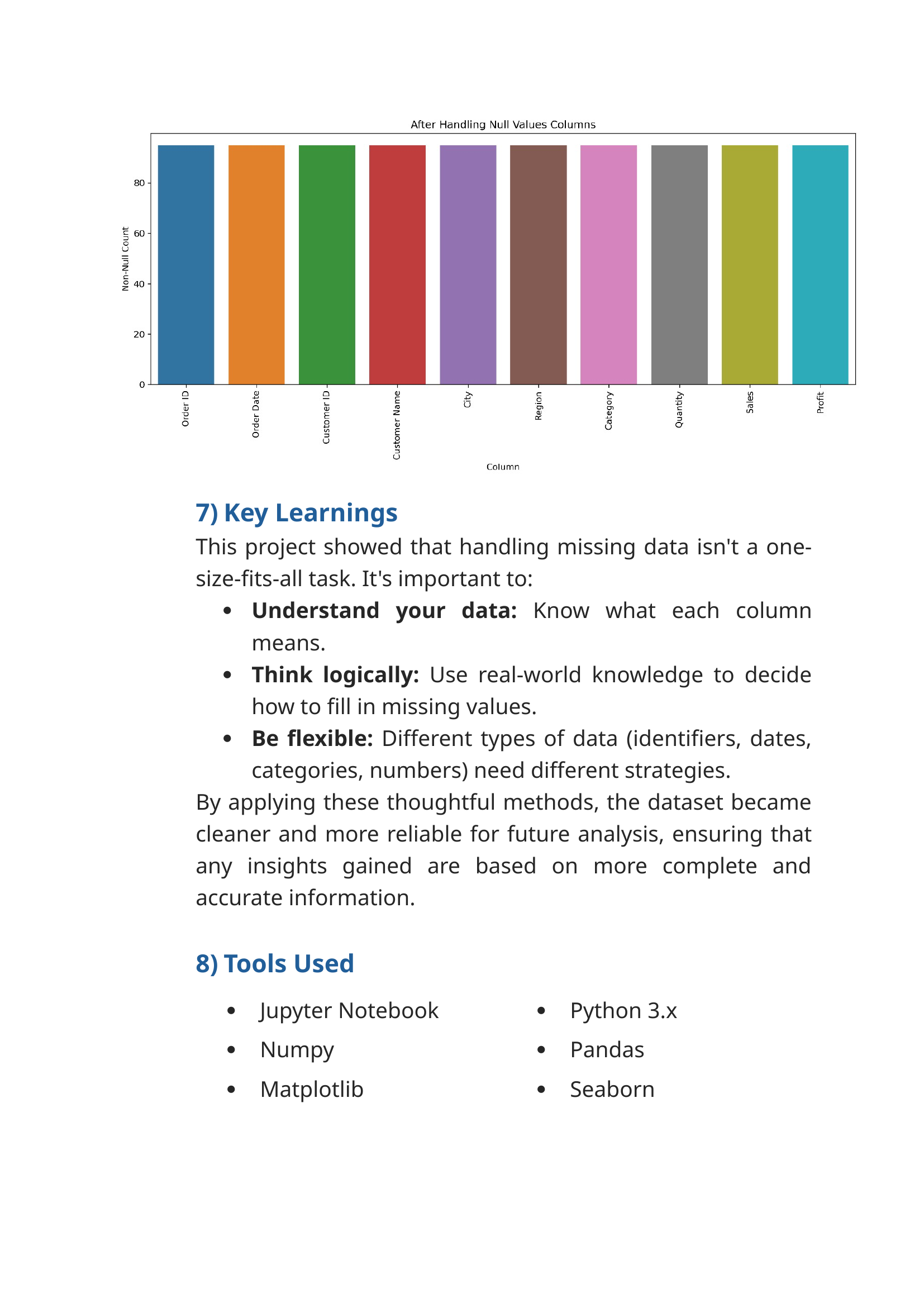
Plot the Chart :
-
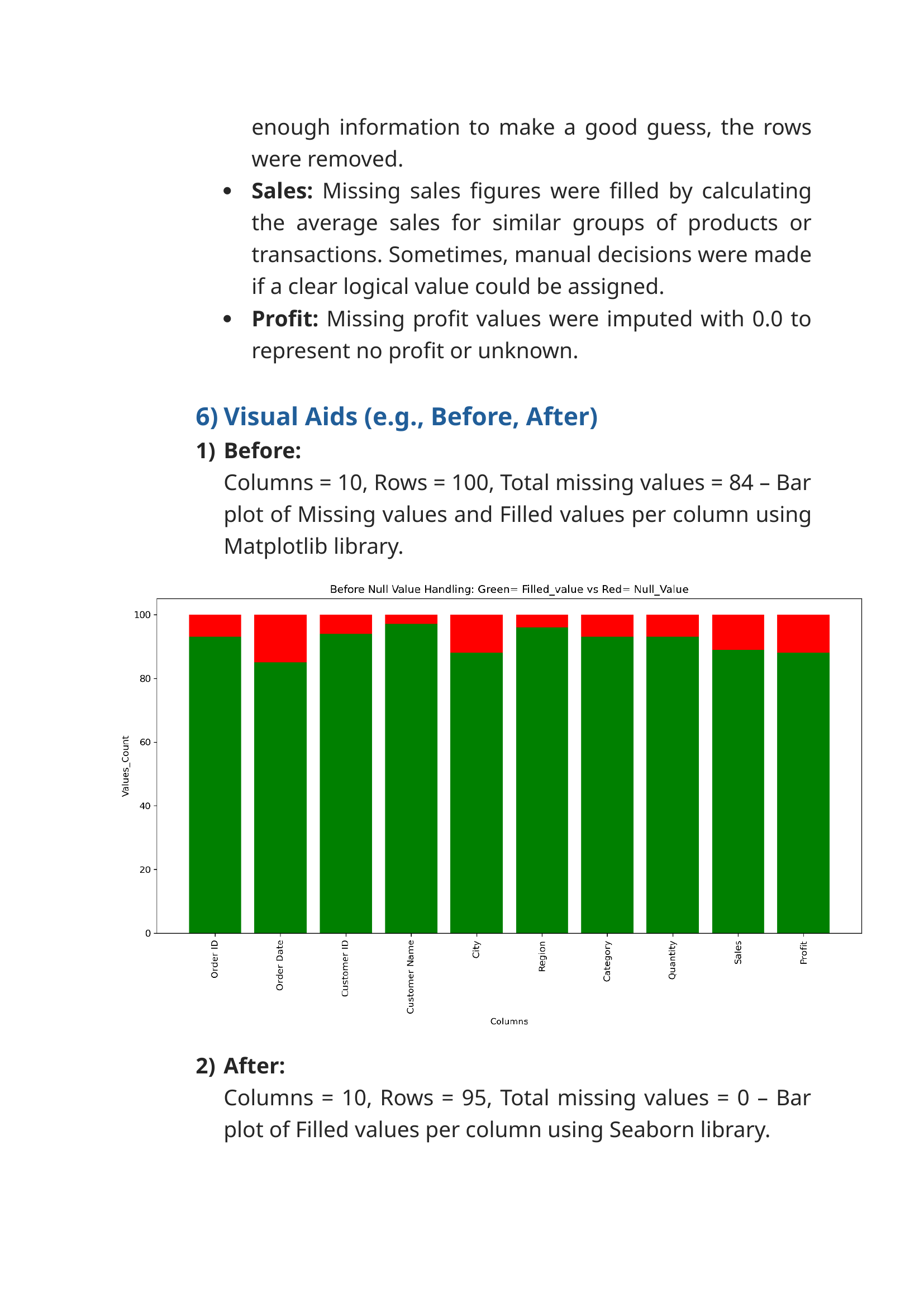
Before Handling null values
-
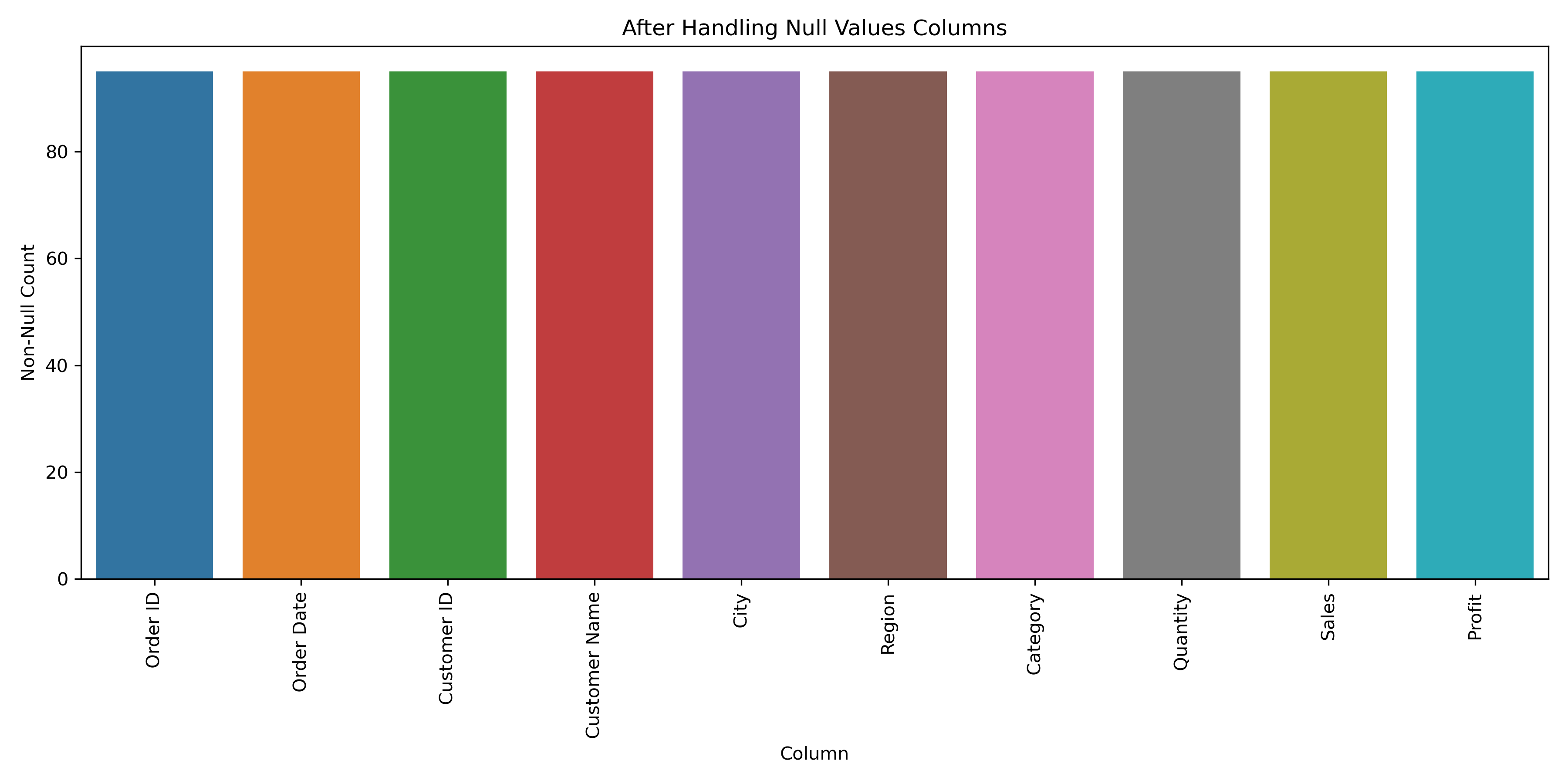
After Handling null values
Final Summary: Column wise Null value Handling Conclusion :
Before Handling null values
df_column = df.columns
df_column
cou = df.count()
df_count = cou.values
df_count
isnull = df.isnull().sum()
isnull_count = isnull.values
isnull_count
fig, ax = plt.subplots(figsize= (12,7))
ax.bar(df_column, df_count, color= "green")
ax.bar(df_column, isnull_count, bottom= df_count, color= "red")
ax.set_xlabel("Columns")
ax.set_ylabel("Values_Count")
plt.title("Before Null Value Handling: Green= Filled_value vs Red= Null_Value")
plt.xticks(rotation= 90)
plt.tight_layout()
plt.show()
df.info()
After Handling null values
df_handled_missing_values = pd.DataFrame(df_num)
df_handled_missing_values.head()
df_handled_missing_values.reset_index(drop= True, inplace= True)
non_null_counts = df_handled_missing_values.notnull().sum().reset_index()
non_null_counts.columns = ['Column', 'Non-Null Count']
plt.figure(figsize=(12, 6))
sns.barplot(data=non_null_counts, x='Column', y='Non-Null Count')
plt.title('After Handling Null Values Columns')
plt.xticks(rotation=90)
plt.tight_layout()
plt.show()
df_handled_missing_values.info()
Final Summary: Column wise Null value Handling Conclusion :
1) Order ID :
-
Filled with
"Unknown"since all values are unique identifiers.2) Customer ID :
-
Filled with
"Unknown"due to uniqueness of values.3) Customer Name :
-
Filled with
"Unknown"since all names are unique and avoid misleading results.4) Order Date :
-
Used category-region-date filtering, counting, and manual imputation based on realworld logic.
5) City :
-
Filled with
"Unknown"— cities are all unique.6) Region :
-
Filled based on city-to-region mapping; dropped one row.
7) Category :
-
Filled based on region-wise product frequency.
8) Quantity :
-
Used category-region-date filtering and manual imputation.
9) Sales :
-
Filled using group-based mean or manual logic. Some rows dropped.
10) Profit :
-
Nulls filled with
0.0to avoid misleading results.
🛒 Walmart Null Value Handling Project Documentation